
Ten minutes of national choreography: when Sweden decided everyone would turn the wheel at once
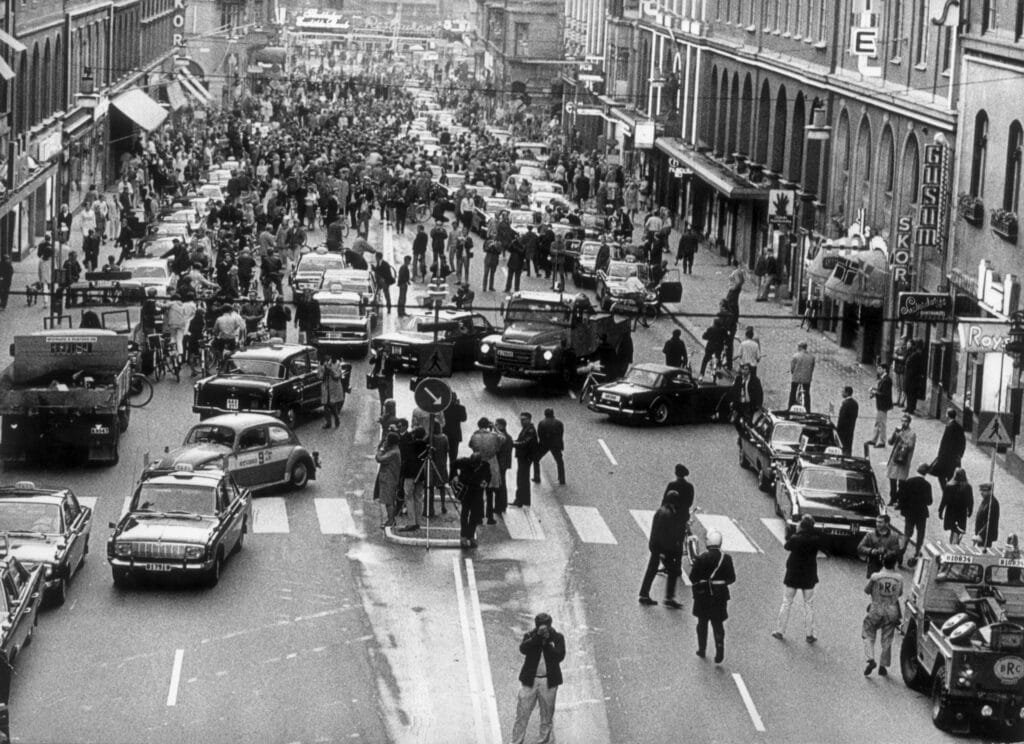
At 4:50 a.m. on September 3, 1967, thousands of cars sat still in Sweden, as if the whole country had pressed pause. It was not a strike or an epic snowstorm: it was a full dress rehearsal with real traffic in the starring role. Ten minutes later, at 5:00, those same cars would set off again—but on the other side of the road. In the blink of an eye—or, more accurately, ten very deliberate minutes—Sweden changed the direction of traffic across the entire country.
The scene sounds like domestic science fiction: imagine opening your closet one morning to find that, by government decree, every hanger now has to face the opposite wall. Nothing has changed, and yet everything is different. The steering wheel is where it always was, the car is still yours, and the streets are the same. But habit—that autopilot that saves you and sometimes gets you into trouble—has just been switched off.
If you want to see footage and get some context for the switch, this video brings those ten minutes to life.
The strangest part: people had already voted no
The “this sounds fake” part is not just the change itself; it is the backstory. In 1955, Sweden held a referendum on whether to switch from left-hand to right-hand traffic. The result was clear: most people wanted to keep driving on the left. And yet, twelve years later, the country did exactly the opposite.
The referendum was not a joke. Politics and international logistics were simply pushing in a different direction. Sweden was surrounded by countries that drove on the right, and cross-border traffic—especially with Norway and Finland—turned every trip into a small exercise in mental gymnastics. Many Swedish cars already had the steering wheel on the left, too (as cars designed for right-hand traffic do), which put drivers in a worse position for passing while driving on the left: like trying to look out a window from the wrong side of the couch.
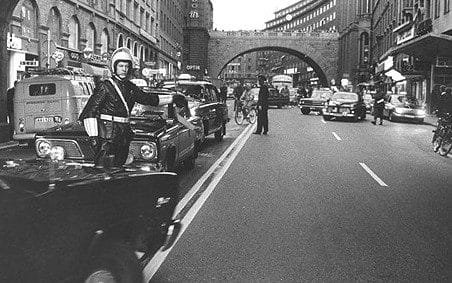
So the government decided that even though most people had said “no,” the change was inevitable. The date was set: Dagen H, or “H Day.” The H stood for Högertrafik, Swedish for right-hand traffic. It sounds like the name of a military operation—and, in a way, it was: an operation in public order, urban planning and collective psychology.
The morning of the switch: stop, breathe and move
The plan was as simple as it was nerve-racking: stop traffic and get it moving again on the other side. In practice, it was a colossal choreography. On the morning of Dagen H, vehicles on streets and highways had to stop and carefully move into the new lane. At 4:50, traffic was ordered to halt; at 5:00, it resumed, now on the right.
Ten minutes may sound like nothing. But think about how long it takes to adjust to sleeping on the other side of the bed when you travel: you wake up and, for a second, have no idea where you are. Now multiply that disorientation across an entire country, with buses, trucks, cyclists, pedestrians and traffic lights. And there was one important detail: it was not enough to “drive on the right.” Drivers had to do it on a network of streets designed for the opposite system for decades.
To make it work, Sweden had to turn an abstract decision into physical instructions: painted lines, new signs, traffic lights reoriented, bus stops moved to the other side. If you have ever tried reorganizing a kitchen and realized that moving the coffee maker also means moving the outlet, mug, sugar and the motion of your hand, imagine a kitchen the size of a country.
Covered signs, new road markings and a country full of reminders
One of the most striking—and photogenic—images from Dagen H is that of covered signs, ready to be “unveiled” at exactly the right moment. Many old signs were removed or hidden, while the new ones waited their turn like theater scenery before the curtain rises.
Road markings were repainted and intersections adjusted, too. The change was not just about “the road”: it affected turning patterns, merges, where pedestrians stood to cross and how drivers read an intersection. A turn that had once felt comfortable could suddenly demand a second look.
And of course, there was public transportation. Buses could not keep opening their doors on the wrong side, dropping passengers into traffic. Vehicles had to be modified or replaced, and stops had to move. It is the sort of detail that rarely makes a headline but determines whether the day goes smoothly or turns into chaos.
What about crashes? The “everyone is being extra careful” effect
Your first instinct is probably: “That must have been a disaster.” But what happened at first was very human: people drove with almost exaggerated caution. When autopilot switches off, the brain takes over and every move becomes deliberate. It is like walking down a dark hallway: you go more slowly, sure, but you also pay attention to every step.
That extra caution is often cited as one reason the change did not trigger the immediate collapse many had feared. That does not mean there were no incidents or confusion—there were—but the great traffic apocalypse never arrived as popular lore might suggest. For a while, driving demanded a little more respect in Sweden, and that respect acted like a psychological airbag.
The Swedish paradox: democracy, pragmatism and neighbors
There is something fascinating about a country known for order and consensus making such a drastic turn despite an earlier referendum against it. But the story of Dagen H is not “democracy failed.” It is a lesson in what happens when people’s preferences collide with systems of interdependence.
Driving is not a private habit; it is a shared choreography. You cannot decide to drive on whichever side you like, just as you cannot decide that everyone in your building should go up the stairs on the right and down on the left. Coordination is the actual product. When your system clashes with your neighbors’, the costs pile up: at borders, in transportation, in vehicle design and in road safety.
So Sweden eventually chose pragmatism. Not without resistance or debate, and not without a huge operation to keep the change from becoming a mess. At heart, Dagen H was a reminder that many things we consider “natural” are really invisible agreements. One decision—and ten minutes of silence on the road—can reveal how fragile those agreements are.
An entire country relearns the obvious
The most impressive thing about Dagen H is not the logistics, though those were impressive. It is the psychological scale: millions of people forced to relearn an everyday gesture. Turn, look, merge, pass. Everything you do without thinking suddenly requires thought.
There is a small irony here: the change was meant to reduce friction with the outside world, but for a while it increased the friction inside each driver. To fit in better with the world, people had to accept a private discomfort, a temporary awkwardness. In the first few days, Sweden was a country with a novice driver sticker on its forehead—even though people had been driving for twenty years.
In time, of course, the new normal settled in. The brain is a creature of habit: today, driving on the right in Sweden feels as obvious to most people as water being wet. But the story remains, like a crack in the wall reminding you that the wall had to be built.
And Dagen H leaves behind an awkward, beautiful question: how many things that seem “natural” today are really collective agreements that could change—not in decades, but in ten minutes—if the world around us pushed hard enough?
For more context, read about Dagen H, the day Sweden switched to driving on the right, or this account of how Swedish drivers experienced the 1967 lane change.