
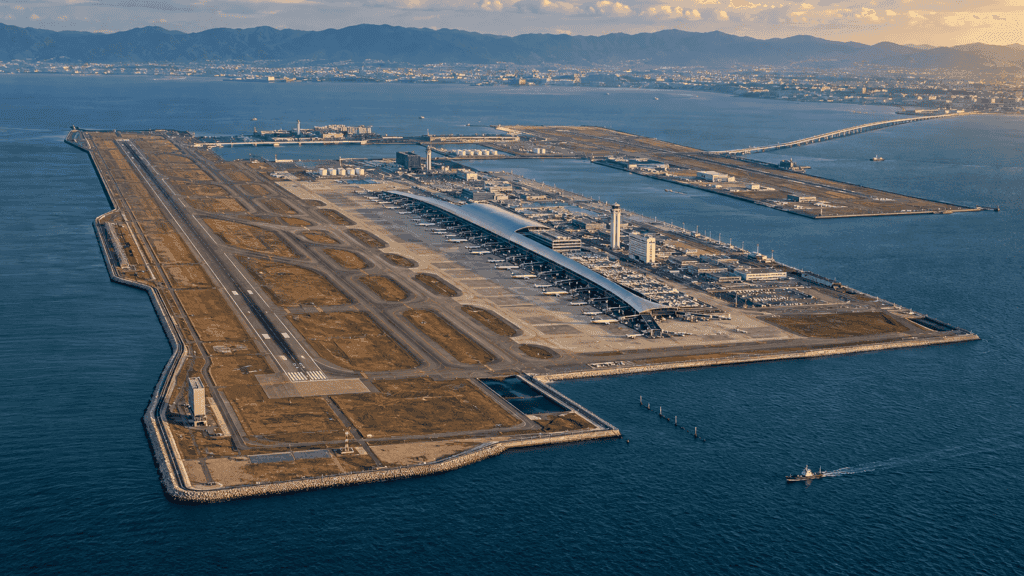
When planes land at Kansai International Airport, they land on an island that did not exist until the late twentieth century. It sits about five kilometers off Osaka’s coast, above soft marine clay that compresses slowly under the weight of fill, runways and terminals. The project did not eliminate that movement: it learned to measure it, compensate for it and keep operating with it.
Osaka needed a night runway
By the 1960s, Osaka’s Itami Airport was constrained by its urban setting and night-flight limits. Kansai was conceived as an offshore alternative, far enough away to reduce noise for residents and large enough to operate around the clock. The site offered space, but it also imposed a geological problem: an artificial island would settle for decades.
Construction began in 1987. Engineers created a first island of roughly 510 hectares, surrounded by seawalls and filled with enormous volumes of rock and sand. The first phase opened on September 4, 1994. A second island later added another runway and terminal capacity.
A million ways to drain water
The ground beneath Kansai contains deep layers of soft clay. Under new weight, water escapes slowly from the pores and the clay consolidates. To accelerate that process, the project used nearly a million vertical sand drains in the first phase, generally spaced around one meter apart; the second phase used a denser pattern of roughly 1.2 meters. The drains shortened the path water had to travel and helped engineers predict settlement before the most sensitive structures were built.

Renzo Piano’s terminal had to accommodate that condition. Instead of treating the building as a rigid object on fixed ground, its designers incorporated adjustable structural connections. Hydraulic jacks at key columns allow the building to be raised when settlement makes correction necessary.
Measuring in order to rise
At Kansai, settlement is not a surprise discovered after construction; it is a monitored variable. The airport uses observation points, level surveys, extensometers and control systems to track how the ground, seawalls, runway and terminal behave. Seventeen key observation points make it possible to compare expected movement with what is actually happening.
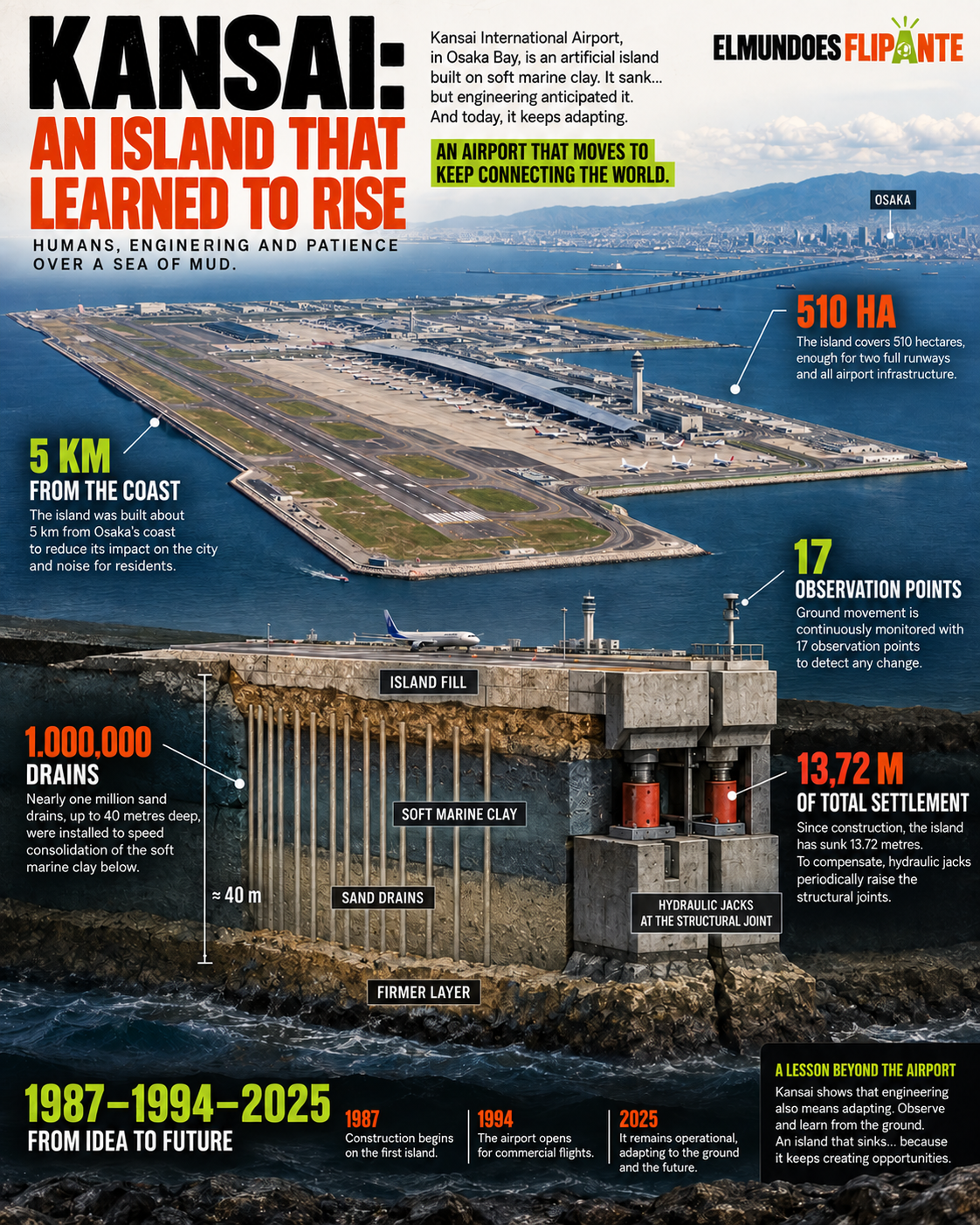
By December 2025, the first island’s cumulative settlement was reported at 13.72 meters. That figure sounds alarming only if it is taken out of context. The island was designed to settle; what matters is the pace of movement, whether it stays within projected ranges and whether the infrastructure can be readjusted safely.

An island tested by the sea
Kansai has faced more than settlement. The 1995 Kobe earthquake tested its systems soon after the airport opened; the island withstood the event without major structural damage. In 2018, Typhoon Jebi flooded parts of the airport and damaged the access bridge, leading to a major operational interruption and a new round of resilience work.
The island is also an environmental project. Kansai Airport has reported efforts to create and maintain seagrass habitat along its revetments; around 66 hectares of seagrass meadow are monitored near the airport. It is not a return to the original coast, but it recognizes that the edge of a constructed island can still support marine life.
This video shows the scale of the construction and the engineering involved in creating an airport on reclaimed land:
What they really built
Kansai is not simply an airport placed on a man-made island. It is a long-term control system: drains beneath the fill, seawalls around the perimeter, instruments inside the ground, adjustable columns in the terminal and maintenance routines that assume change rather than deny it.
The lesson is not that engineering can make the ground stop moving. The lesson is that it can observe movement closely enough to design around it, correct it when necessary and keep a complex public system open while the ground continues its slow transformation.
Infrastructure that accepts movement
Many large works are judged by their apparent permanence. Kansai offers another model. Its durability comes from accepting that some conditions will evolve: clay compresses, sea levels change, storms arrive and equipment needs adjustment. The airport survives not because it is immobile, but because it was built to be read, maintained and corrected.
That is why its story is more interesting than a simple megaproject. Beneath every boarding gate is an island that is still settling, still being measured and still being raised by millimeters when the data says it should be.
Sources consulted for this article
- Kansai Airports — airport history, operations and sustainability information.
- Japan Science and Technology Information Aggregator — engineering papers on Kansai’s settlement and ground improvement.
- Arup — engineering context for adaptable structures and airport infrastructure.
- Construction video — visual record of Kansai’s reclamation work.