
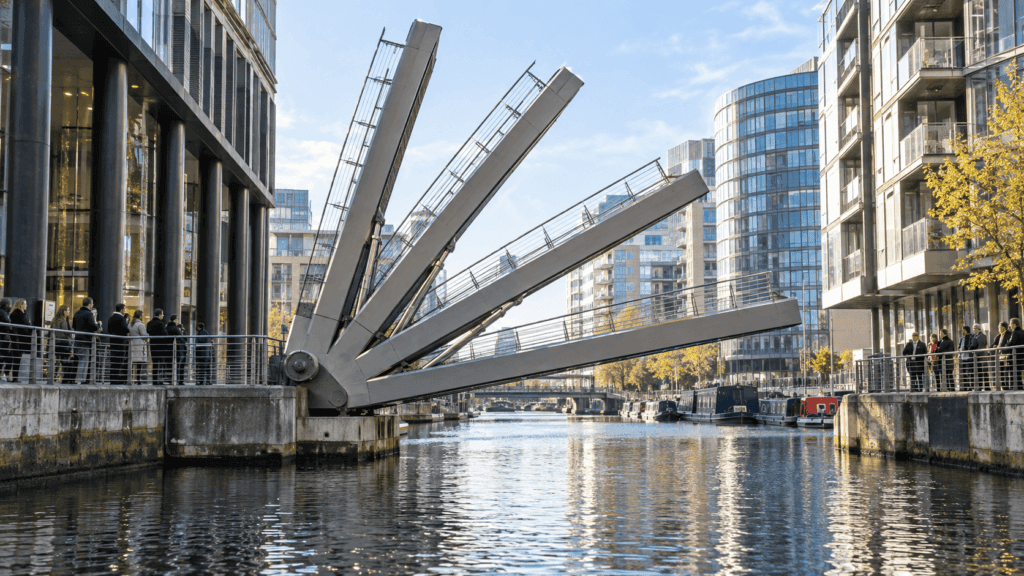
When a boat enters the Grand Union Canal, Merchant Square Footbridge does not rise as one whole piece. Its five steel leaves open in sequence like a mechanical fan, and the promenade is joined again only minutes later. At Paddington Basin, the movement is not an added spectacle: it is the precise answer to a canal that must remain navigable.
A footbridge that behaves like an urban clock: it waits for the boat, then gives the square back to pedestrians.
A fixed bridge would have forced a choice between boats and pedestrians. This one does not choose: it steps aside.
Two incompatible flows
The canal carries boats; the square needs pedestrians. A fixed footbridge would have created an obstacle, and a large ramp would have consumed public space. Knight Architects turned the deck into five narrow elements that rotate around an axis. When no boat is passing, they form a continuous surface about three meters wide.
The division also solves a problem of scale. A single long leaf would concentrate weight and require larger machinery. Five pieces reduce rotational moment and allow each segment to move through its own mechanism. The result is a structure that looks light but is calculated to withstand daily traffic, wind and vibration.
The mechanics are visible
- Signal: the system checks that the canal and bridge are clear.
- Lift: hydraulic jacks raise each leaf around its axis.
- Return: the five segments align again to restore the crossing.
Each leaf incorporates a longitudinal beam and turns through hydraulic jacks. Molded counterweights balance part of the weight before the system begins to raise it. Sensors, locks and controls check that the deck is clear and that the sequence can run without interfering with pedestrians or boats.
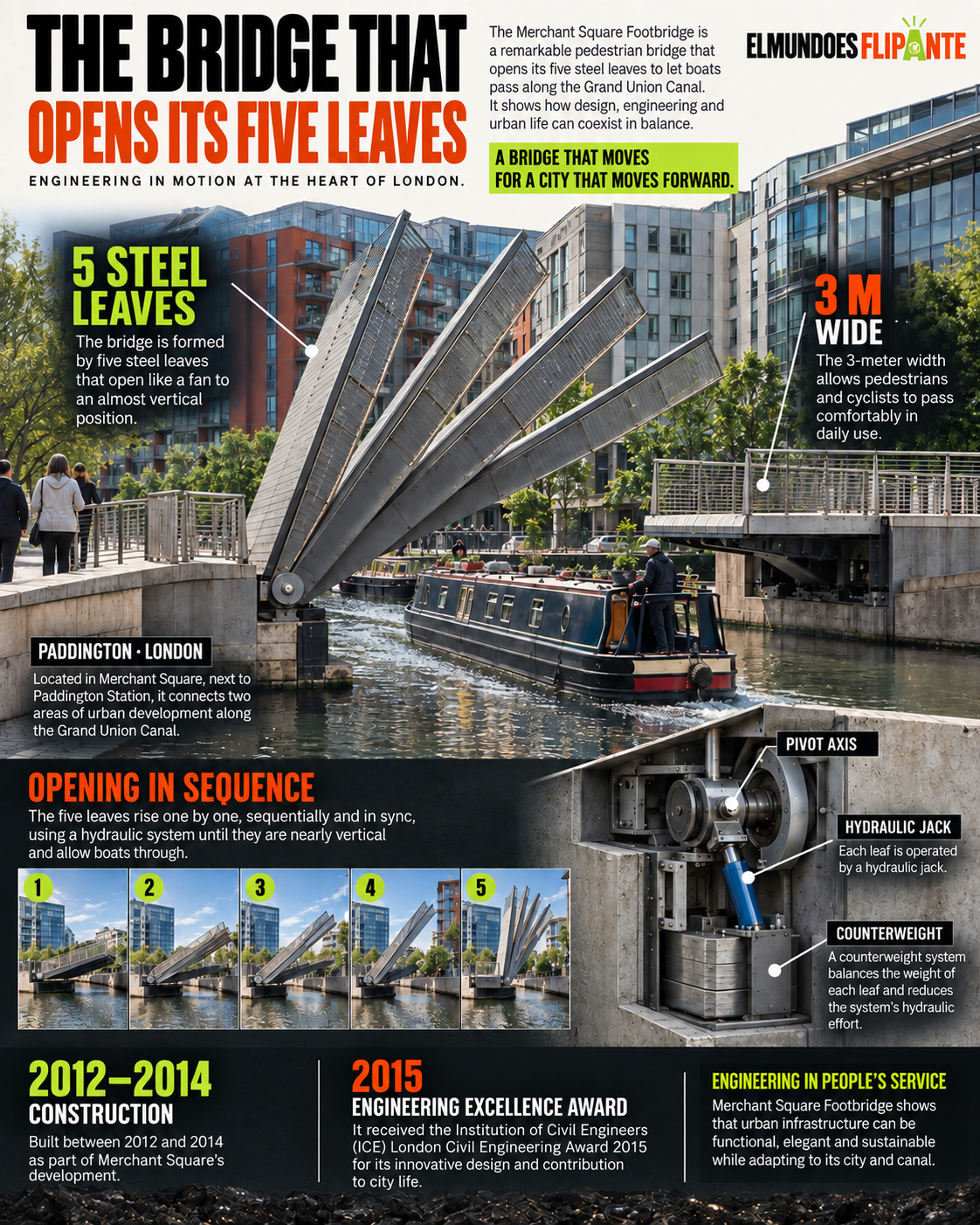
The opening lasts only a few minutes, but it makes visible what infrastructure usually hides: forces, axes, tolerances and energy.
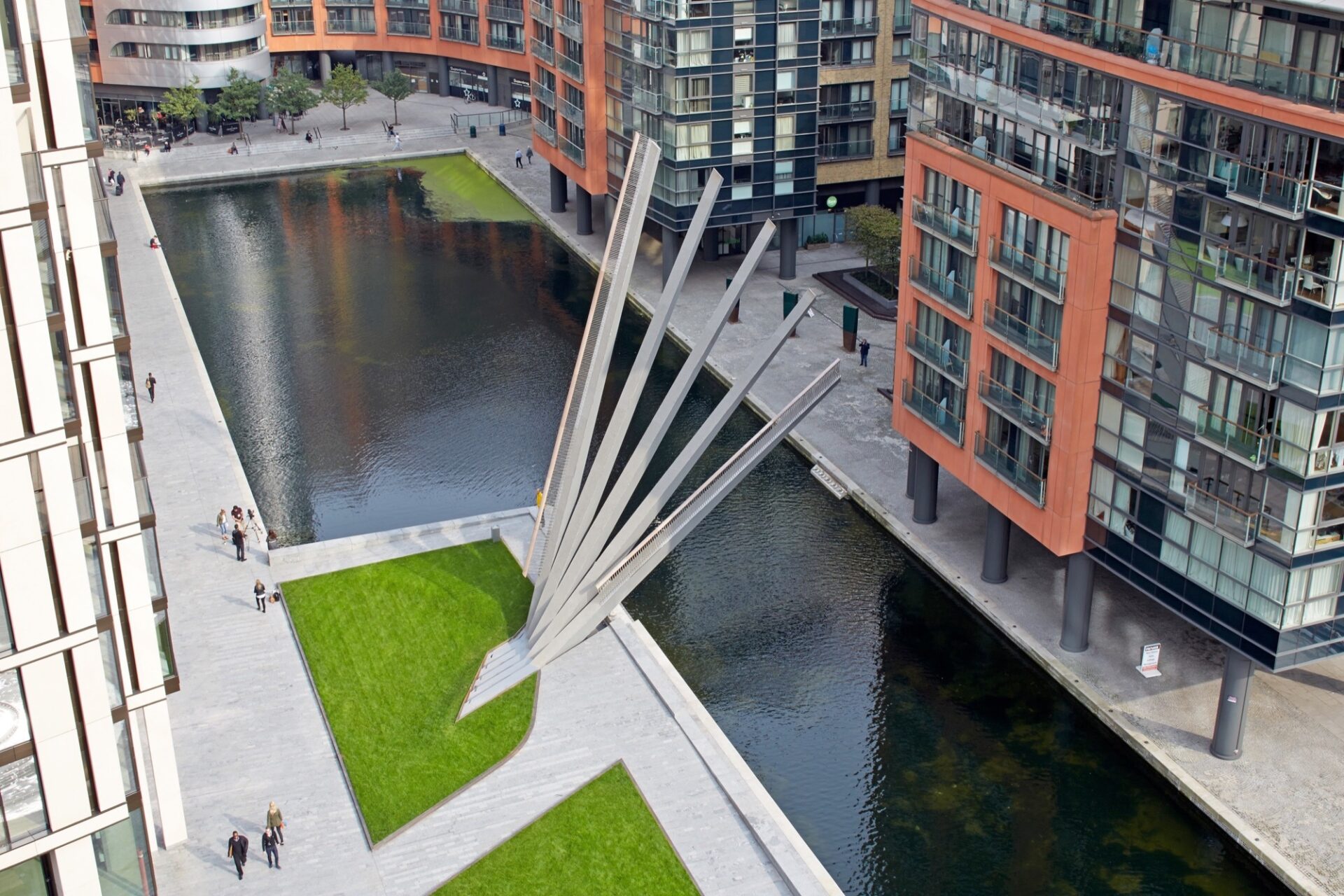
The public sees the leaves separate, reach position and fit together again. The kinetic sculpture emerged from solving the structural problem, not as decoration added afterward.

The project also requires thinking about maintenance and safety. The five arms do not move together on a whim: the sequence distributes forces, keeps joints clear and allows the maneuver to stop if a sensor detects an unexpected presence. In public infrastructure, that redundancy matters as much as the elegant form visible from the promenade.
An urban piece
The program was developed between 2012 and 2014 and received a Structural Steel Design Award in 2015. Its presence in Paddington Basin connected offices, homes, bars and waterside routes. It also appeared in Jason Bourne (2016), though its daily function is more interesting than its film cameo.
The footbridge shows that engineering can be legible. Each leaf moves aside only when necessary, the canal continues to work and the square regains continuity. An urban constraint becomes a scene anyone can understand.
This YouTube video shows the full opening and the coordination among the five leaves:
The fan that keeps the canal alive
The bridge does not try to dominate the water. It steps aside, waits and returns to position. That choreography captures a powerful design idea: when two uses cannot occupy the same place at once, a movable structure can make both work without giving up the city.
When a mechanism becomes landscape
The bridge operation is designed to coexist with everyday canal life. Boats do not have to wait for a barrier to be dismantled and pedestrians do not need to learn a complicated protocol. Signage warns them, sensors check the space and the sequence stops if something does not fit. Those small decisions explain why the bridge looks so simple when closed.
There is an urban dimension too. Paddington Basin moved from industrial edge to a place for walking, and the bridge acts as a hinge between shores with different uses. Its silhouette changes with the hour: horizontal and almost discreet when it connects the square; vertical and theatrical when it lets water through.
For engineers, the challenge does not end with raising the leaves. Vibration, corrosion, drainage and bearing wear all need control. Preventive maintenance stops small clearances from changing the distribution of forces.
The result is a piece that does not hide its operation. Watching it open helps show that design can be clear without being simplistic, and spectacular without being superfluous. Five leaves, hydraulic jacks and precise choreography let canal and city share one space.
From a project perspective, the lesson transfers. Dividing a large piece into moving modules reduces forces, makes maintenance easier and offers more control options. Not every bridge must open like a fan, but many urban problems are solved better when design accepts movement rather than trying to freeze it.
Scheduled openings also reduce conflict between navigation and pedestrian mobility: each use has its moment and the square regains continuity without permanent construction.
Sources consulted for this article
- Knight Architects — Merchant Square Footbridge project and design decisions.
- Institution of Structural Engineers — Technical context for movable footbridges and steel structures.
- British Constructional Steelwork Association — Awards and structural-steel solutions.
- London Canal Museum — Historical and navigation context for London’s canals.
- YouTube: Paddington Basin Fan Bridge — Video of the bridge’s sequential opening.