
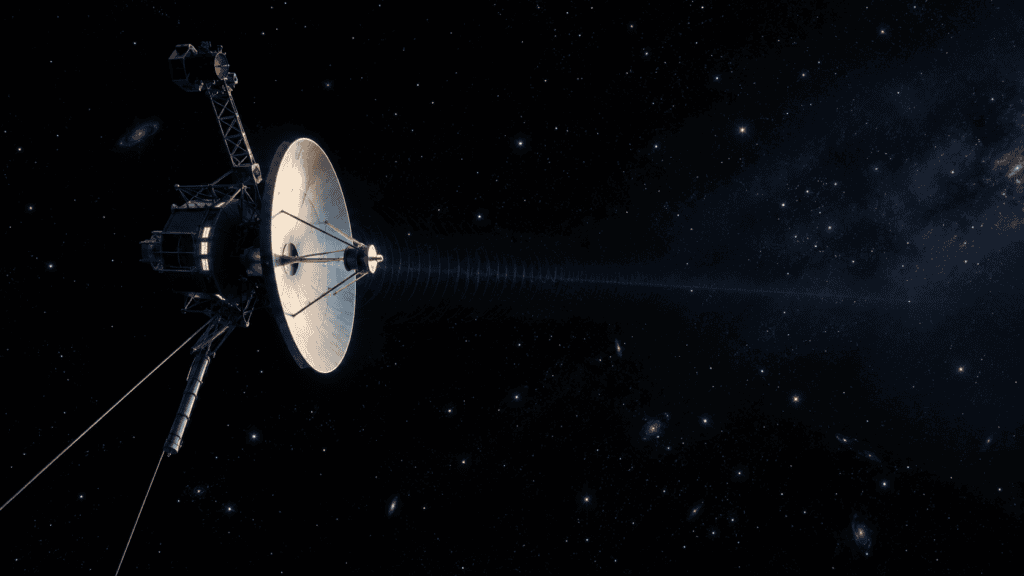
A command leaves Earth and takes more than twenty hours to arrive. The reply needs just as long. When an engineer sends an instruction to Voyager 1, they are not waiting for an immediate acknowledgment: they are accepting a conversation lasting more than a day with a machine launched in 1977. That delay says more than any single figure about the distance of the farthest human-made object.
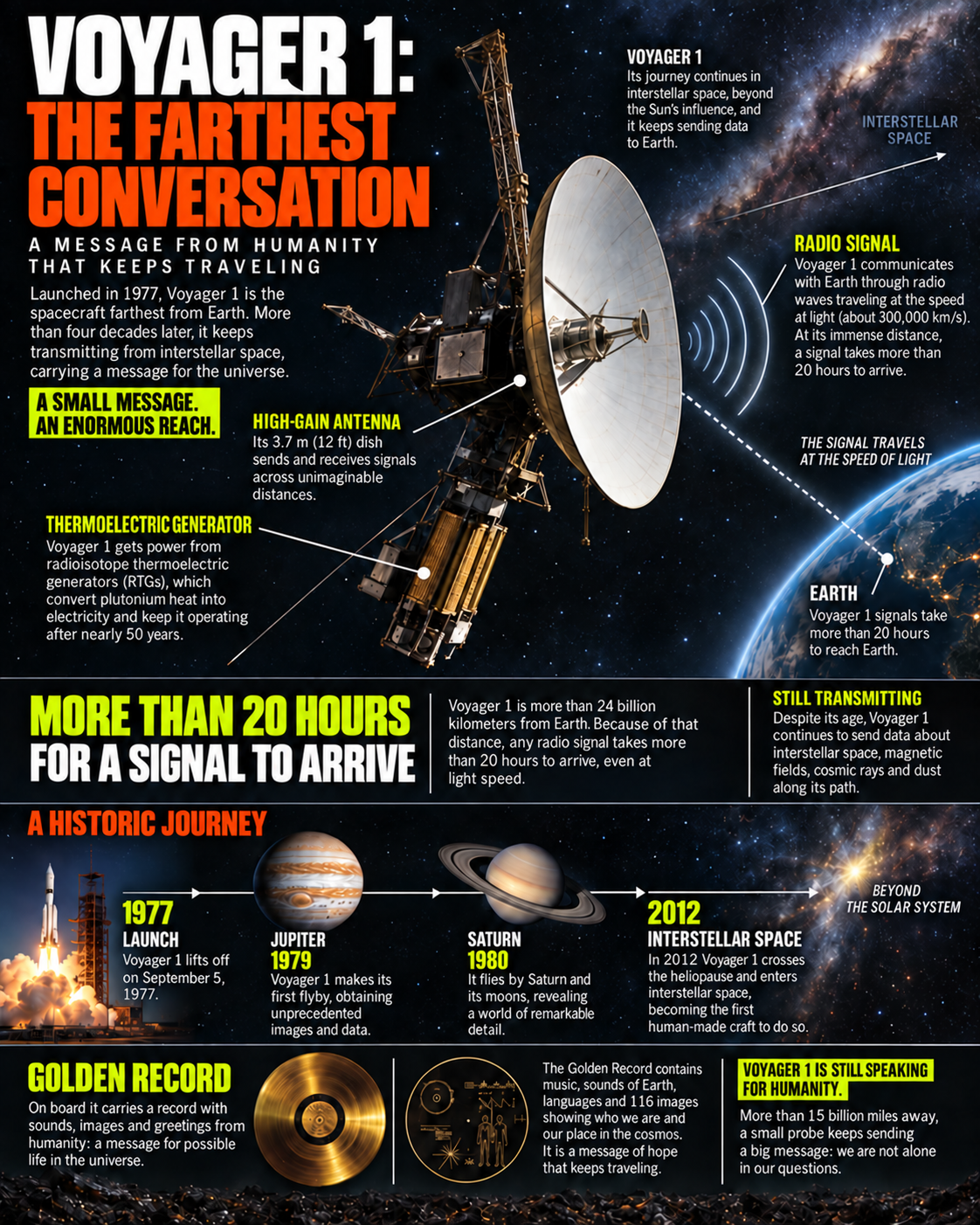
Voyager 1 lifted off from Cape Canaveral on September 5, 1977. Its initial mission was not to leave everything behind: it was meant to study Jupiter and Saturn. The gravity assists of the giant planets changed its trajectory; its encounter with Titan sent it out of the plane of the planets. NASA’s timeline lets us follow that journey as a sequence of decisions that could not be repeated once the spacecraft had launched.
In 1998, it passed Pioneer 10 as the most distant human-made artifact. In 2012, it crossed the heliopause, the dynamic boundary of the plasma bubble dominated by the Sun. The word “boundary” needs care: Voyager has not left the galaxy or escaped every gravitational influence of the solar system. It left the region where the solar wind clearly dominates. NASA’s Voyager 1 mission page explains it with a precision that is less cinematic and more interesting.

A scale that does not fit on a map
Distance is often expressed in astronomical units: one AU is the average distance between Earth and the Sun. The spacecraft is moving away at about 17 kilometers per second, although the number changes slightly depending on the reference frame. In kilometers, the figure is impressive; in radio time, it becomes understandable. No video call is possible when every “hello” needs nearly two days to complete the round trip.
The spacecraft no longer photographs planets. Its cameras were turned off in 1990 to save energy, memory and transmission capacity for particle instruments. That final gesture produced Pale Blue Dot: Earth reduced to a pixel in a band of light. The photograph is famous, but its real oddity lies in the earlier decision to turn the camera when there was no scientific gain left in the frame.
NASA summarizes Voyager 1’s journey and the time scale of a mission that still sends data in this video:
The record and the machine that refuses to retire
Voyager carries the Golden Record, a cultural capsule with sounds, images and greetings from Earth. NASA preserves an explanation of the record, including the cover that works as a symbolic manual for anyone who might one day find the spacecraft. It is a message sent without a known recipient, with a patience no email could imitate.
Its power comes from radioisotope thermoelectric generators. Their output declines over time, so teams turn off instruments and rewrite software to stretch every watt. At times, a faulty signal or damaged memory forces them to reconstruct a problem from minimal telemetry. The JPL status page shows the mission for what it is: not a motionless relic, but a remote system that still requires intellectual maintenance.
The antenna points at a tiny conversation
The most striking thing about Voyager is not only how far away it is, but how hard it is to hear. Its high-gain dish must stay pointed at Earth while the craft rotates, cools and loses power. At the other end, Deep Space Network antennas receive a signal weakened by billions of kilometers. A telemetry datum that would fit on a line here travels as an extraordinarily slow conversation, full of checks and error-correction codes.
The comparison with a mobile phone helps show the gulf. A phone connects to a nearby tower, changes antenna if we move and can resend a data packet without our noticing. Voyager has no spare tower waiting around the corner. If it stops responding, engineers must decide whether the problem is the instrument, software, power supply or radio path. Each hypothesis takes hours to receive an answer. It is maintenance with permanent jet lag.
The Golden Record adds an almost literary layer to a very practical machine. It contains greetings, sounds of Earth, music and images selected to offer a compressed portrait of our species. It is not a perfect capsule: no selection can represent eight billion people, and the message assumes an intelligence able to find it, read it and want to interpret it. That is precisely why it is interesting. Voyager carries a cultural sample inside a vehicle built to measure particles and magnetic fields.
The famous Pale Blue Dot also began with an engineering decision. After the spacecraft had passed its major planetary encounters, Carl Sagan and the team proposed turning the cameras back. The result was not a useful image for adjusting trajectory or calculating atmospheric composition. It was an image that reminds us scale changes the narrative: from far away, Earth does not look like an epic stage, but a fragile pixel suspended in a band of light.
The mission’s lifespan depends on concrete tradeoffs. Every instrument turned off frees energy for another; every command must be written for a computing architecture no longer manufactured; every anomaly requires consulting decades-old documentation. The craft still works because teams read old manuals, rebuild routines and accept that the most elegant solution is not always possible. Sometimes victory means a sensor delivers a few more bits for another week.
That is why “the farthest human-made object” may be too small a phrase. Voyager 1 is not only a distance record: it is a demonstration of continuity. We launched it, listened to it, turned off its cameras, preserved its message and still try to understand every noise it sends back. Its journey has no spectacular ending. It has something rarer: a slow, almost silent departure in which the machine moves away while Earth keeps learning how to speak with it.
Guinness maintains it as the most remote human-made object, but the record is not a fixed medal. The distance changes every second and the signal arrives ever weaker. Voyager 1 is not “lost” in space: it remains connected to us by a slow, fragile and extraordinarily persistent conversation.
Distance, then, is not only a number for a table. It is a working condition. Every command must be written with a machine in mind that cannot receive real-time help, and every reply requires accepting that the past arrives late. Voyager turns waiting into part of exploration.
Sources consulted for this article
- NASA: Voyager 1 — Mission, trajectory and overall status.
- NASA: Voyager Fast Facts — Timeline and principal figures.
- JPL: Mission Status — Communications and instruments.
- NASA: Golden Record — The record’s content and meaning.
- NASA: Pale Blue Dot — Context for the photograph.