
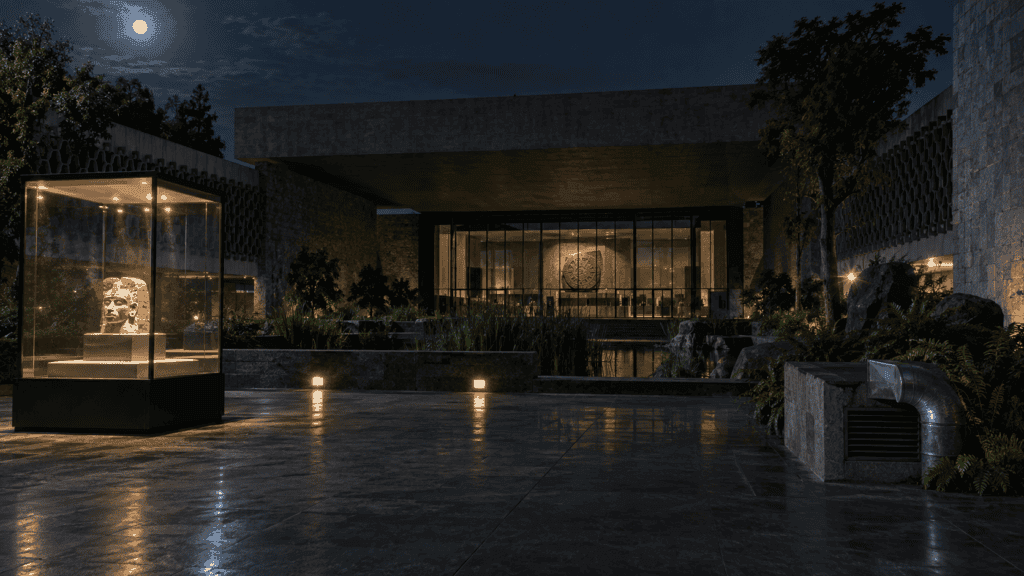
On the night of December 24, 1985, Mexico’s National Museum of Anthropology was closed to the public. That sounds like a guarantee. It turned out to be the opposite. Two veterinary students had visited the museum dozens of times, studied its display cases and routes, and chose a date when the security routine could ease. There was no “calendar error”; there was a human routine made more predictable by the calendar.
Carlos Perches Treviño and Ramón Sardina García entered through an air-conditioning duct. They did not need an action movie or an explosion; they needed to know the building better than the people guarding it that night. Contemporary coverage in The Washington Post recorded the initial impact and confusion over the number of objects taken.
Early reports spoke of 140 objects. The consolidated inventory usually puts the figure at 124. That difference is not a minor detail: it shows how a story changes as it moves from the alarm of the first morning to an item-by-item catalogue. The objects included Mexica pieces, including an obsidian vessel shaped like a monkey. They were not “archaeological souvenirs”; they were objects with context, provenance and heritage value.
The physical route of the heist
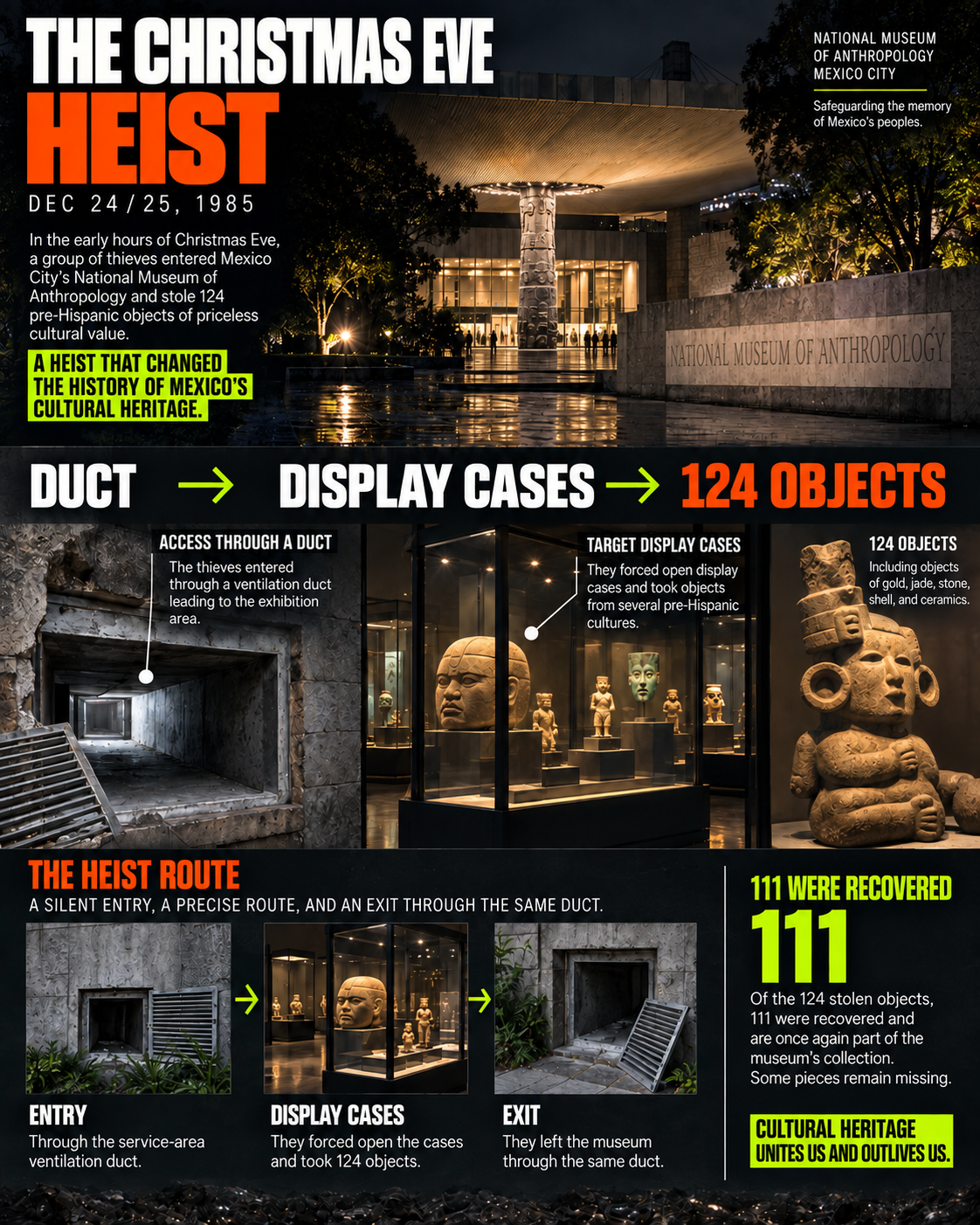
The duct offered a discreet entrance and connected to exhibition areas. The thieves had turned the museum into a map of timings: they knew which display cases were farthest away, how long a patrol took and where they could move without meeting a guard. The Christmas date did not eliminate security, but it altered attention, shift changes and staff concentration.
The theft was discovered during the guard change on Christmas morning. The gaps in the display cases said more than any alarm could. For years, the objects remained hidden in a family closet. In 1989, 111 objects were recovered; Sardina was never located. The INAH provides the institutional context for understanding why recovery did not close the case: every object still had to be documented, safeguarded and returned to its place in collective memory.
One hundred and twenty-four objects do not fit into a movie scene
An inventory is one of the least glamorous and most important parts of a heritage theft. On the first morning, different figures circulate, objects from nearby cases get mixed together and the press looks for a number that fits in a headline. Then comes the slow work: comparing catalogues, photographs, conservation records and gallery logs. That is why it is worth distinguishing the initial figure of 140 objects from the consolidated count of 124. It is not a contradiction to hide; it is the trace of how a documentary response is built.

The stolen objects included Mexica, Maya and other pre-Hispanic works. Each had a context that cannot be reduced to its price. An obsidian vessel, a mask or a jewel are not interchangeable simply because they stood in the same case. Their material, provenance and relationship to other objects tell a story about techniques, rituals and trading networks. When they disappear, the museum also loses part of the argument that allowed visitors to understand them.
The air-conditioning duct has become the icon of the case, but the duct alone does not explain its success. The thieves had to observe schedules, memorize routes, estimate timings and decide which display cases could be opened without too much noise. Christmas reduced visitor traffic, but it did not turn the building into a place without rules. The heist worked because a series of small decisions fit together for a few hours, like a key made from habits.
The recovery of 111 objects four years later was not a clean ending either. Each object had to be identified, checked for damage, connected to the story of its concealment and returned to an institution that had already changed its protocols. The Congressional Record is a reminder that the case went beyond police reporting: it raised questions about protecting cultural heritage, institutional cooperation and the difficulty of pursuing objects that can circulate outside the formal market for years.
Popular culture added another layer. The film Museo is valuable as an interpretation because it shows how a society retells a theft decades later, but it should not be used to settle figures or security details. Film needs pace, characters and scenes that resolve; an inventory needs patience. Confusing the two produces a very entertaining story and a much less reliable one.
The lesson about the calendar is not about blaming one particular holiday. A secure system should not depend on nobody being distracted on December 24 or every shift change going perfectly. Security is designed for unusual days: holidays, shift changes, construction work, unexpected visits and moments when staff are tired. The museum heist shows that vulnerability is not always an open door. Sometimes it is the sum of routines that nobody has questioned again.
The film Museo turned the case into cultural fiction. It can be consulted as an interpretation, not as a source for figures. That distinction matters because famous thefts are often rewritten by film until the duct, the inventory and the guard change seem like parts of a perfect screenplay.
The real engineering of the heist was less spectacular: observe, repeat, wait and take advantage of a date when everyone believed the building would be quieter. A museum does not fail only when a lock gives way; it also fails when the system stops looking at the same time.
The case also left an uncomfortable question about the value of memory. Recovering the objects did not mean returning them to exactly the same mental place they held before. The museum had to explain what happened, which measures changed and why its protocols were reinforced. An object can return to a display case, but the institution is no longer the same: it preserves the piece and the scar of having lost it.
This article’s infographic should show that sequence without turning it into an adventure. Calendar, duct, display cases, discovery and recovery form a documentary chain. The important fact is not that two young men appeared smarter than an entire museum, but that security depends on procedures, inventories and people able to spot an anomaly when the building fills with light again.

To see the story in motion, this video helps complete the explanation:
The museum learned that surveillance cannot be measured by the number of cameras alone. It also matters how alarms are checked, who knows the routes and what happens when an exceptional date changes the routine. That is the least cinematic part — and precisely the most useful part for understanding the case.
The story is anchored in two visual objects: the duct through which they entered and the display case that dawned incomplete. Between them, it becomes clear that the vulnerability was not an isolated hole, but a route nobody had mapped as a threat.
The calendar only opened a window; observation and a lack of review did the rest, slowly.
Sources consulted for this article
- INAH: National Museum of Anthropology — Collections, museum history and measures adopted after the theft.
- The Washington Post: 1985 coverage of the theft — Contemporary account of the theft and the initial investigation.
- Congressional Record — Documentary and legislative context for cultural heritage and antiquities trafficking.
- TIME: Art-theft context — Historical comparison with other notable museum heists.
- IMDb: El robo del siglo — Cultural reference for the film inspired by the case.
- Wikimedia Commons: National Museum of Anthropology — Building images and their usage licenses.