
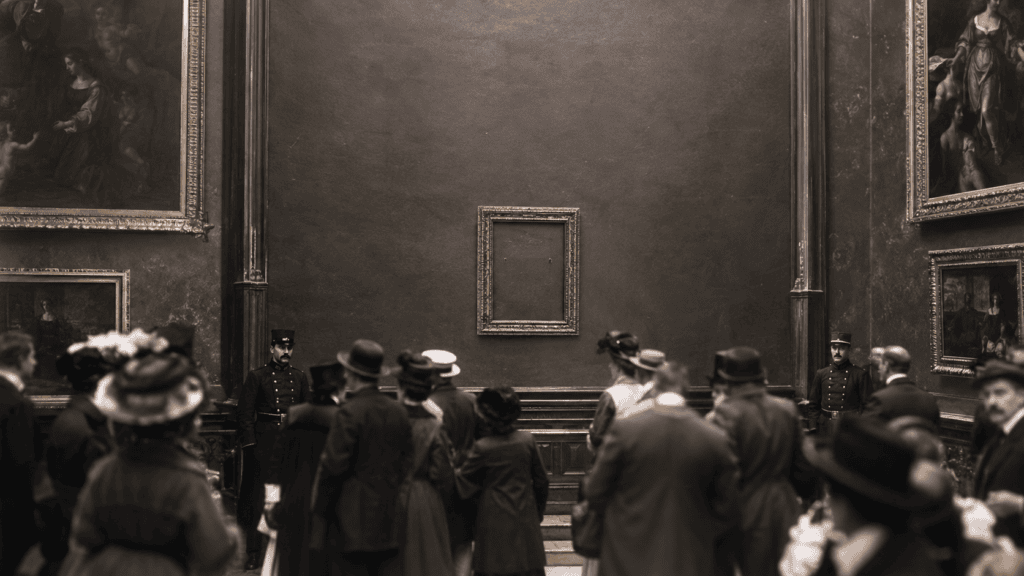
On August 21, 1911, the Louvre had an absence it did not yet know was news. The Mona Lisa had left the building hidden beneath the clothing of a former worker. For a time, the most famous thing in the room was not the painting, but the gap where it should have been. The museum did not discover the theft like a movie, with an alarm and a thief running away; it discovered it by checking a wall that was no longer complete.
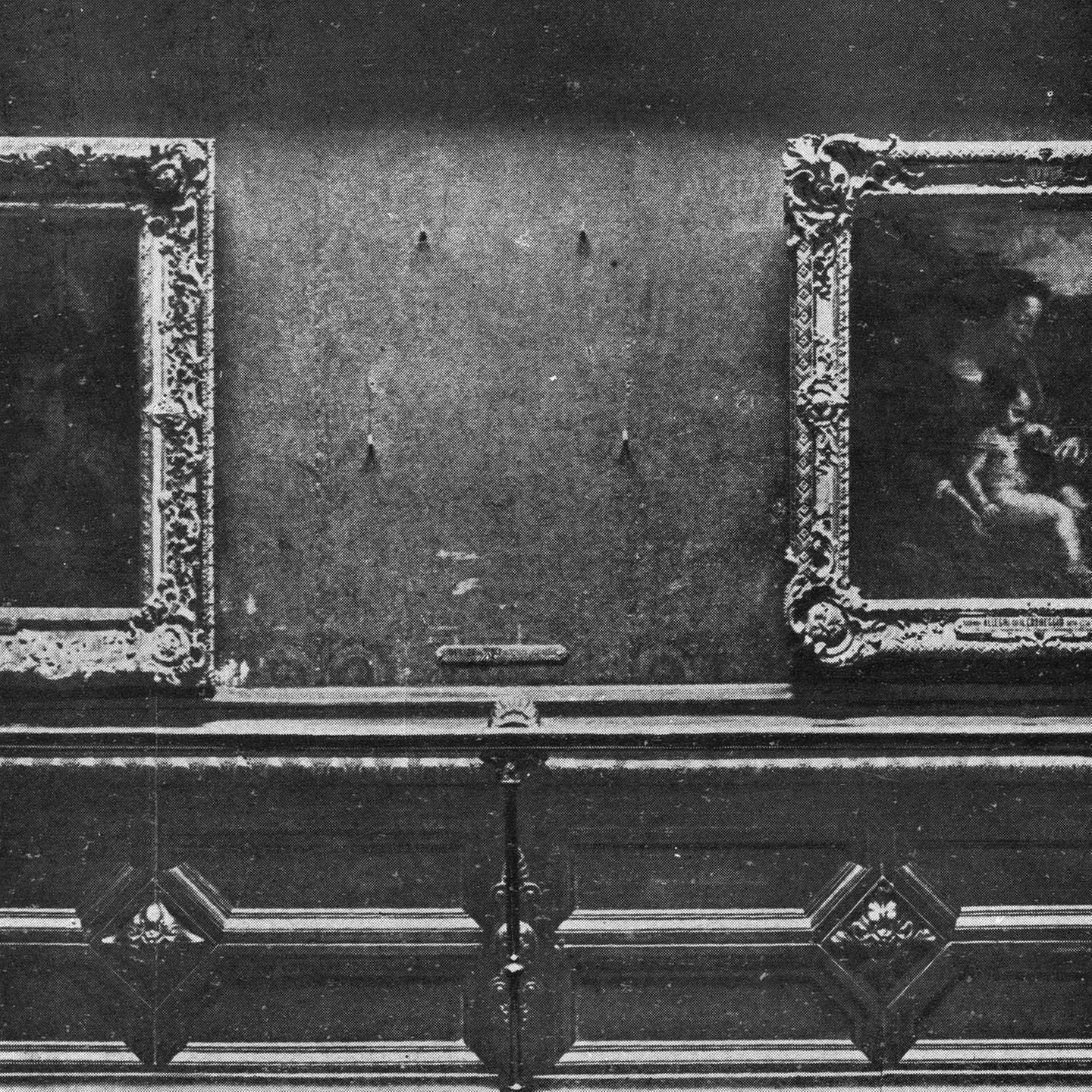
Vincenzo Peruggia knew the building and its mounting system. The Louvre’s institutional history explains how the painting was removed and how the temporary closure turned the case into a public obsession. Detection was not immediate: a visitor or worker noticed the gap the next day, and the checks began.
The investigation reached Pablo Picasso and Guillaume Apollinaire because of links to stolen objects, but neither was responsible. It is a familiar problem in famous cases: the press needs suspects before it has evidence. The declassified FBI file helps separate the documented investigation from the versions that time turned into anecdote.
A trunk and a fixed idea
Peruggia hid the painting in a false-bottom trunk in his apartment. For more than two years, the work remained outside the room that had made it public heritage. In December 1913, he contacted Florentine dealer Alfredo Geri. Geri alerted the authorities, and Peruggia was arrested with the painting.
To see the story in motion, this video helps complete the explanation:
The painting returned to the Louvre in January 1914 after a brief exhibition in Italy. Its return became an international event. Newspaper photographs, queues and reproductions multiplied the image of a work that already had a history, but now also had a disappearance. Smithsonian reconstructs the theft without treating it as the only explanation for the painting’s fame.
An absence can be photographed, too
Images of the empty wall have an unusual force because they document two things at once. They show that the painting was gone, but also the machinery waiting for it: the reserved space, the missing frame, the broken symmetry and visitors staring at something that normally would not have attracted attention. The museum became a witness to its own failure. The absence was visible and, for that very reason, reproducible in newspapers around the world.
The investigation moved through real leads and media noise. Picasso and Apollinaire were questioned because of their connections to stolen works, although neither took part in the theft. The suspicion had narrative logic — artists, collectors and missing objects — but narrative logic is not evidence. The FBI Vault shows that difference: documents, statements and investigative lines sit alongside rumors later embellished by biographies and films.

Peruggia did not need a plan to destroy the Louvre. He used ordinary knowledge of the building and a work that could be moved with relative discretion. The painting left hidden beneath a worker’s clothing and remained in a false-bottom trunk. The image of a thief escaping with an enormous artwork is less accurate than reality: the object was valuable, but manageable; the risk lay in controlling time, not in a spectacular chase.
The empty wall lets us follow the story without inventing a pursuit. First there is the gap, then the questions, then the suspects and finally the lead to Florence. Each image has a different job: the wall records the absence, the file reveals the noise around the investigation, and the recovery photograph returns the object to public view. The sequence matters because the theft was not an isolated instant; it was a chain of decisions spread over more than two years.
The return changed the way people visited the Louvre as well. Those who stood in line did not only want to see a painting; they wanted to verify that the newspaper protagonist had returned to its place. The museum became the stage for a restitution, and the work acquired a public biography far longer than that of its creator. The Mona Lisa’s modern celebrity was built from painting, heritage, press and a perfectly photographable absence.
Peruggia’s arrest in Florence had an almost theatrical element. He contacted Alfredo Geri and presented the painting as a patriotic return. Geri notified the authorities, and the story changed direction: the gesture intended to turn the thief into a savior created the proof that allowed police to arrest him. A clandestine operation can fall apart when it needs public recognition. In this case, vanity came with a mailing address.
This is why saying that the theft “made” the Mona Lisa famous needs a correction. Fame has several layers: Leonardo’s authorship, the French royal collection, the Louvre, mass reproduction, interest in the Renaissance and, finally, the theft. The disappearance was an accelerator because it offered an easy story to remember. A quiet portrait suddenly had a plot, a villain, a journey and an ending.
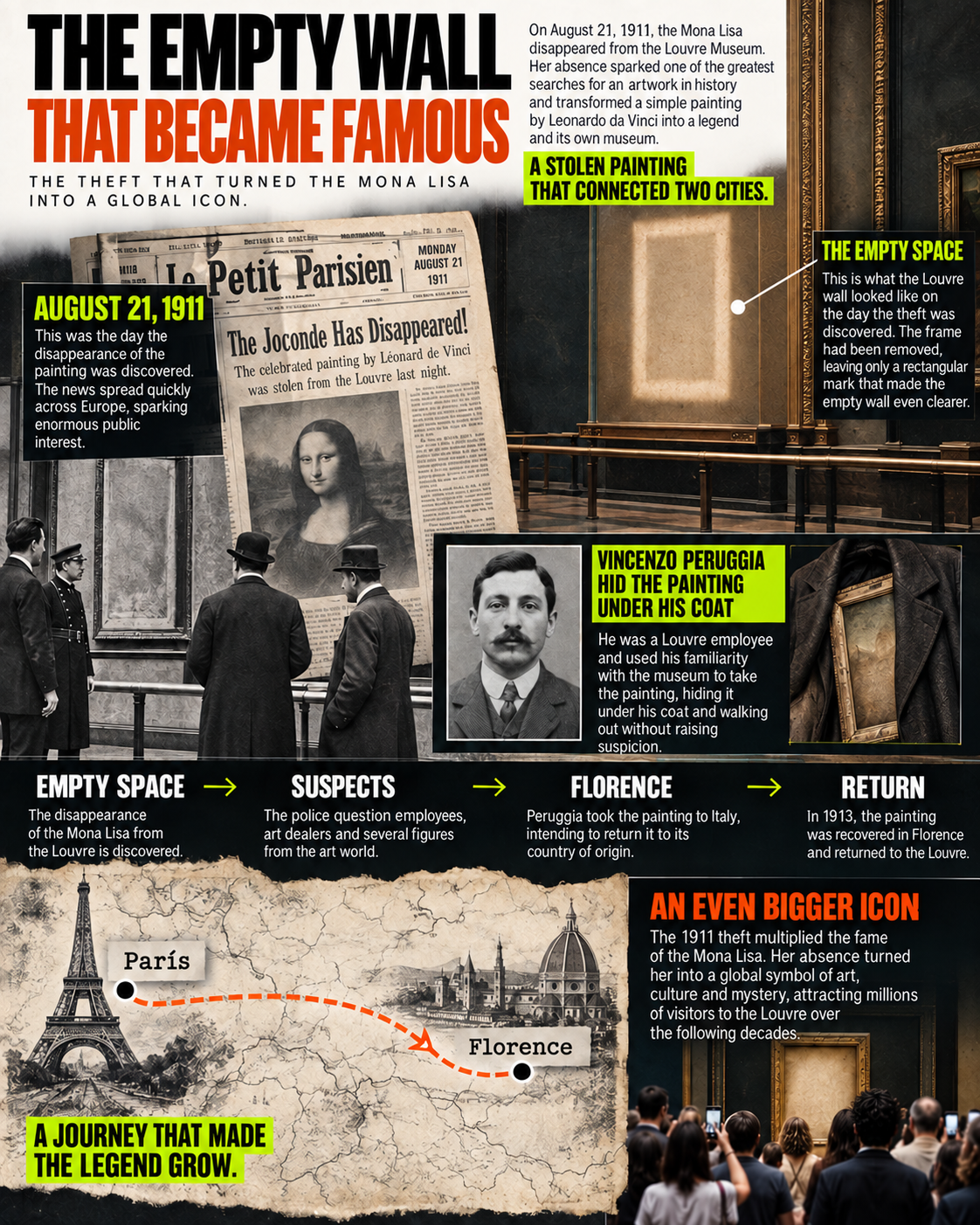
The episode remains useful for thinking about cultural security today. A museum protects objects, but it also protects context: inventories, reference photographs, conservation data and traceability. When an item disappears, the question is not only where it is, but what information has disappeared with it and what narrative the person hiding it is trying to impose. The empty Louvre wall was the first warning of a theft; it was also the beginning of a new way of looking at the painting.
The most powerful image is still the empty wall. A missing painting makes visible the system that protected it: room, frame, surveillance, inventory, press and public. Peruggia wanted to return it to Italy and ended up giving the Louvre a story no director had asked for, but one the museum would never stop telling.
Sources consulted for this article
- Louvre: From Mona Lisa to Mona Lisa — History of the work, its arrival at the museum and its cultural role.
- FBI Vault: Mona Lisa theft — Documentary record of the international investigation.
- Britannica: Mona Lisa — Historical and artistic context for Leonardo’s painting.
- Smithsonian Magazine: The 1911 theft — A readable reconstruction of the empty Louvre wall and recovery.
- Wikimedia Commons: Mona Lisa — Historical images and licenses for the reproductions used.