
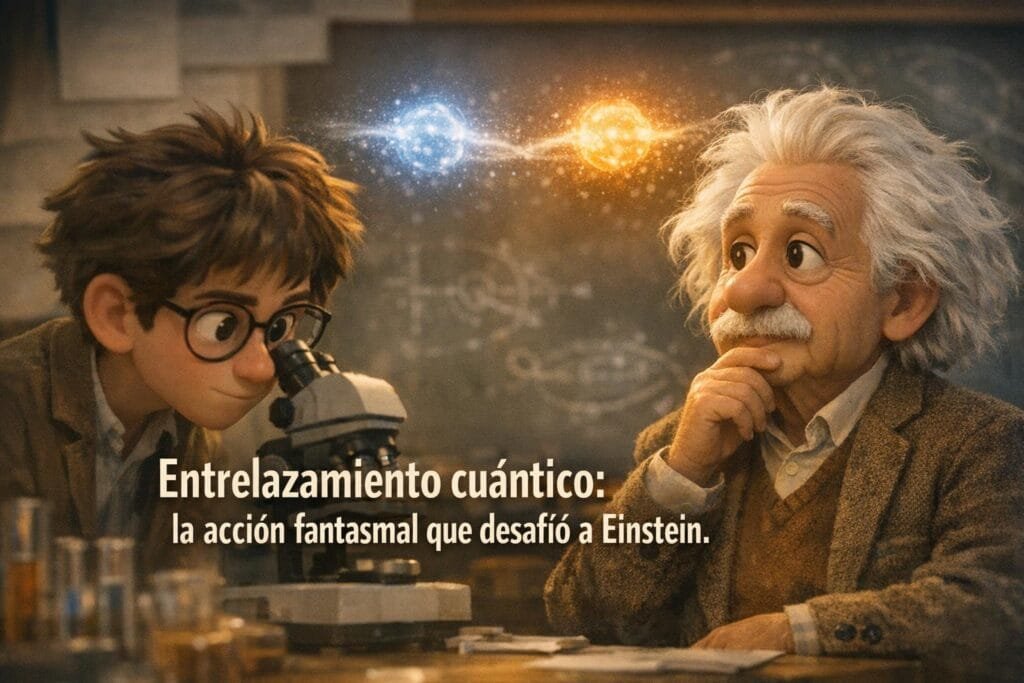
Albert Einstein, the quintessential genius, called it “spooky action at a distance”—an idea so strange he simply couldn’t accept it as real. But reality, dear reader, can be far more mind-bending than fiction. Here’s a thought experiment: imagine two magic coins. If you flip one and it lands heads, the other—no matter where it is—will always land tails. If the first lands tails, the second lands heads. No wires, no sleight of hand, just an apparently impossible connection.
The “spooky action” that drove Einstein crazy
To picture why this idea is so unsettling, the video below offers a clear, straightforward explanation of this strange cosmic connection.
That instant, inexplicably coordinated connection between two separated things is the heart of quantum entanglement. In the subatomic universe, where familiar rules bend and sometimes break, particles can become “entangled,” linking their properties regardless of the distance between them. Measure one, and the result is correlated with what you’ll find when you measure the other. The correlations appear no matter how far apart the particles are—but that does not let anyone send a message faster than light. Yes, it’s as strange as it sounds.
This was a BIG problem for Einstein and his colleagues. Special relativity says nothing can travel faster than light. If entangled particles seemed to affect each other instantly, wasn’t that breaking a fundamental rule of the cosmos? Einstein saw it as an absurdity. He held on to the idea of “locality”: objects can be influenced only by their immediate surroundings. Entanglement seemed to mock that intuition, suggesting that the universe was stranger and more connected than he could accept.
How on earth does this “magic” work?
Here’s where things get even more intriguing. In quantum mechanics, a particle’s properties aren’t always defined in advance of measurement. Think back to our magic coin. Before you flip it and look, it can be described as being in a “heads and tails at once” state (technically, a superposition). Entangle two particles—say, two electrons—and then separate them by millions of miles, and their correlations remain. Measure one electron’s “spin” (a quantum property often compared to a kind of rotation) and find it pointing up, and the result for its entangled partner will be correlated with it. No apparent signal passes between them.
It isn’t that one particle is sending a message to the other. It’s more like they were always part of a single system, and measuring one reveals a correlated result for the other. It’s one system spread across space. Entanglement tells us reality is more interconnected—and less “local”—than intuition suggests.
From spooky to real: the evidence piles up
For decades, entanglement was a philosophical debate and a headache for physicists. Then, beginning in the 1960s, John Bell developed his theoretical work and famous inequalities. Pioneering experiments followed, including those of Alain Aspect in the 1980s, along with many more recent and precise tests. “Spooky action” was no longer just a wild theory. Experiments repeatedly showed that entanglement is real, measurable, and profoundly counterintuitive.
These experiments confirmed that entangled particles violate what’s known as “local realism.” In other words, the observed correlations can’t be explained by local hidden variables of the kind Einstein hoped for. That doesn’t mean particles send usable messages instantaneously: entanglement cannot be used to communicate faster than light.
The future is quantum: why should we care?
Okay, particles do weird things. So what? This is where entanglement stops being just a scientific curiosity and becomes part of a genuine technological revolution. Its potential applications are mind-blowing.
- Quantum computing: Today’s computers use bits (0 or 1). Quantum computers use qubits, which can be in superpositions of 0 and 1. Entanglement lets qubits share correlations that quantum algorithms can use to tackle certain problems in ways classical computers cannot efficiently match. It doesn’t make every calculation exponentially faster, but it may help with problems beyond the reach of classical supercomputers.
- Quantum cryptography: Entangled particles can be used in quantum communication protocols. Attempts to measure quantum states can disturb them and reveal eavesdropping, although real-world security depends on the protocol and its implementation. This is not an automatically unbreakable communication channel.
- Quantum teleportation: This isn’t like Star Trek, where you turn into particles and appear somewhere else. It means transferring an unknown quantum state to another particle at a distance, using entanglement plus ordinary classical communication. The state itself doesn’t physically travel through space, and the process cannot transmit information faster than light.
Quantum entanglement is undoubtedly one of the strangest and most fascinating ideas in modern physics. It pushes us to reconsider what reality is, what distance means, and how the universe works at its most fundamental level. And although “spooky action at a distance” still sounds like magic, it’s already helping shape technologies Einstein, for all his genius, probably never imagined.
What other surprises does this astonishing universe have in store? If this physics puzzle has sparked your curiosity, keep exploring the mysteries of science at El Mundo es Flipante. Reality beats fiction.