
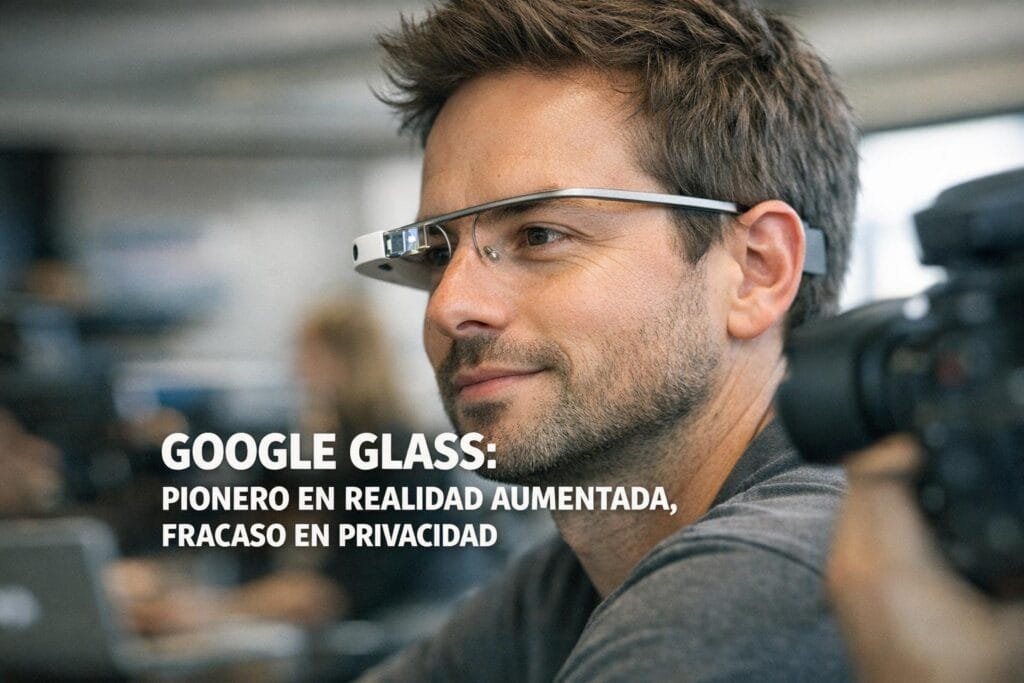
You’re at a bar, chatting, when you suddenly notice someone wearing futuristic-looking glasses pointed right at you. Would you feel comfortable? Or would a wave of unease wash over you as you wondered whether you were being recorded without your consent? That image, unfortunately, became the epitaph for one of the most ambitious—and controversial—technology projects of the last decade: Google Glass.
A revolution! That’s how it was pitched: a giant step toward a future where digital information would blend seamlessly into our field of vision. But what happened? How did something with so much potential fall apart so spectacularly, becoming a running joke about privacy and questionable design?
The dream of an always-on display
It was 2012 when Google, the Mountain View giant, unveiled Project Glass. The vision was dazzling: lightweight glasses with a small prism display that projected information into your right eye. You could get directions, check the weather, take photos, record video, send messages, or even make video calls—all without taking your phone out of your pocket.
Anticipation exploded. In an iconic demo, skydivers jumped from an aircraft wearing Glass and livestreamed what they saw. The whole world was stunned. People imagined the device changing medicine, education, work, and everyday life. Google Glass promised to be the next big leap in personal computing after the smartphone. The “Explorers”—a select group of developers and early adopters who paid a whopping $1,500 for the test version—felt like an elite already living in the future.
The hard truth: from fascination to rejection
The honeymoon didn’t last long. Not long at all. As the Google Glass Explorer Edition began appearing on the streets, initial fascination gave way to a strange mix of curiosity, discomfort, and eventually outright rejection. Why? This is where an innovation story ran headfirst into human nature.
The privacy specter: its real Achilles’ heel
This was, without a doubt, the biggest obstacle and the most devastating blow. The tiny camera built into the glasses’ frame, designed to capture the world as you saw it, became a symbol of intrusion. People began to worry that they were constantly being recorded or photographed without consent, without even knowing it. The derogatory term “Glassholes” emerged to describe people who wore them in public.
- Discreet recording: The ability to record video with a voice command or a light tap was seen as a direct threat to privacy. There was no clear visual indicator that the camera was active.
- Constant suspicion: In bars, restaurants, bathrooms, and even casual conversations, Glass created an atmosphere of distrust. Who wants to be in the public eye without knowing it?
- Widespread bans: Many businesses, from movie theaters to casinos, explicitly prohibited Google Glass, fearing for customers’ privacy or copyright infringement.
It was a cruel paradox: technology designed to connect us to the digital world ended up disconnecting us from people in the real one.
Questionable design and no clear use case
Beyond privacy, other problems were obvious. Although futuristic to some, the design felt uncomfortable and conspicuous to most. It didn’t fit easily with people’s personal style. You looked like a secret agent in a B-movie. At $1,500, it was also prohibitively expensive for most people, and battery life left a lot to be desired.
But perhaps the biggest mistake, aside from privacy, was the lack of a truly compelling use case for the average person. Was it a smartphone replacement? Not really. Did it offer something so revolutionary that it justified the price and odd appearance? For most people, the answer was a resounding “no.” The “Explorers” had a cool gadget to show off, but no everyday use that made a meaningful difference in their lives.
The end of an era—and a quiet transformation
In January 2015, Google announced it would stop producing the Explorer Edition. That was the end of Glass’s ambition as a mass-market consumer product—a spectacular failure. It disappeared from public view, but not entirely.
What few people know is that Google Glass didn’t die; it changed. It returned as Google Glass Enterprise Edition, aimed at industry and business. In factories, warehouses, or operating rooms, where hands-free access and real-time contextual information matter and privacy concerns can be managed in a controlled environment, Glass found a niche. Away from the curious eyes of the street, it operated quietly, proving its worth in a very specific setting.
Total failure or misunderstood pioneer?
The story of Google Glass is fascinating because it teaches us crucial lessons. It shows that technological innovation, however brilliant, cannot ignore the human factor. Social acceptance, privacy, and relevance to everyday life matter just as much as the engineering that makes a device possible. Glass was a pioneer in augmented reality, clearing a path for future devices now returning with force in the metaverse and the AR/VR headset ecosystem.
So, was it a failure? As a mass-market consumer product, absolutely. But as an experiment—a preview of the future that pushed us to think about technology and our social boundaries—it was a resounding success. It forced us to ask: how much privacy are we willing to trade for convenience and access to information? With every new technological leap, the question becomes more relevant. Would you wear Google Glass today if someone promised you the future, but charged that small price in privacy? Keep exploring these intriguing intersections of technology, society, and the future here at El Mundo es Flipante.
Keep exploring technology and its limits
- If you want more stories about ideas ahead of their time, check out the Aerotrain, the French hover train that arrived before its time.