
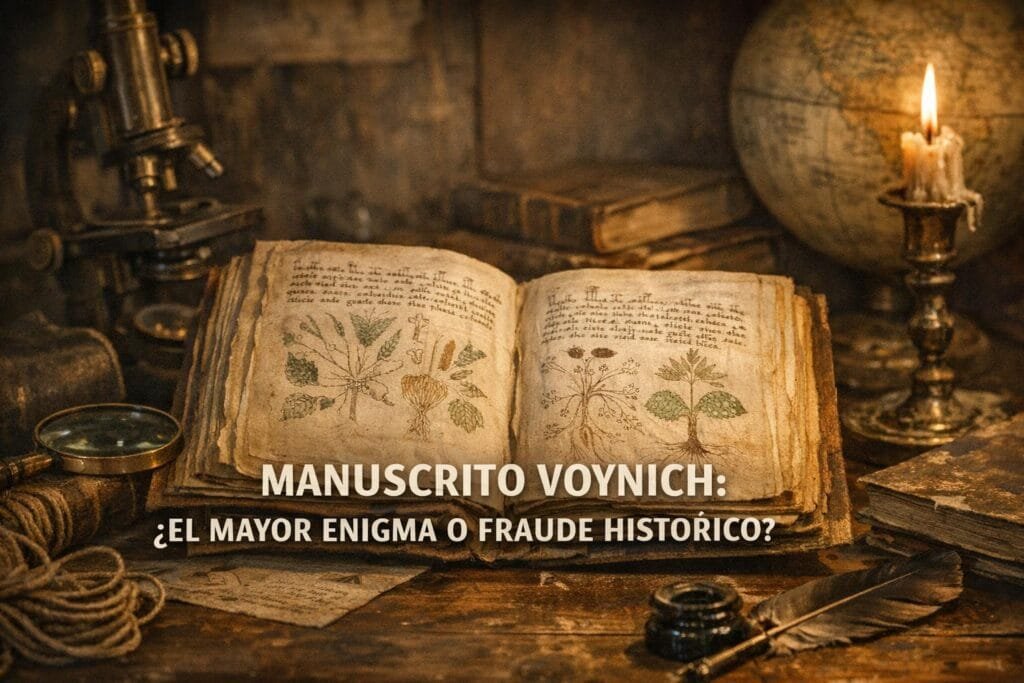
Picture this: you’re one of the finest codebreakers of your age, or a linguist with a Ph.D. who has unraveled mysteries from the past. You’re handed a text more than 600 years old. You think this is your moment—the ultimate challenge, the one that will make your name in history. You sit down, roll up your sleeves, and… fail spectacularly. Again and again. For centuries, the sharpest minds on the planet have stared at the strange curves and dots in this book and had to shrug, completely defeated.
It’s almost ironic, isn’t it? In a world where we’ve deciphered hieroglyphs, dead languages, and wartime codes, there’s a book that seems to laugh in the face of every attempt to understand it. A manuscript that seems to say, “You know a lot, but not enough for me.” I’m talking about the Voynich Manuscript. If you thought you’d seen every kind of historical oddity, get ready to feel as baffled as the experts who’ve spent their lives studying it.
Want to see the strange object before we go on? Here’s a video tour that sets the scene for the mystery.
The first appearance of the “monster”
Our protagonist steps out of history’s shadows in 17th-century Prague—not with a bang, but in a rather exasperated letter. A man named Georg Baresch, an alchemist, owned the strange volume. We call it strange because even then he had no idea what it was. Desperate, he wrote to a learned Jesuit, Athanasius Kircher, famous for deciphering exotic languages, and asked for help. Baresch described the manuscript as a “book of indecipherable hieroglyphics.” Kircher was intrigued—perhaps a little too confident—but never solved the mystery.
After that, the book passed among emperors, collectors, and scholars: a curious relic no one could read. It was like owning a treasure map written in a language not even intergalactic pirates could understand.
An alphabet from another world—and even stranger illustrations
Holding the Voynich Manuscript is a surreal experience from the start. It’s a small volume of about 240 pages, though some are thought to be missing, bound in vellum. But its contents are what hit you when you open it. The book is written entirely in an unknown alphabet, with a natural-looking flow and no corrections—as if the author really knew what they were writing.
And it gets even stranger. The text is accompanied by hundreds of illustrations, grouped into sections that experts have provisionally named:
- Botanical: Plants that don’t appear in any known herbarium. Some have roots from one species, leaves from another, and flowers that look as if they came from a parallel universe. Are they extinct species, fantasies, or the work of an extraterrestrial botanist?
- Astronomical: Celestial diagrams, constellations that don’t match our stars, and symbols suggesting a study of the cosmos wholly unlike anything we know.
- Biological: Perhaps the most puzzling—and, let’s be honest, the most entertaining—section. Naked or half-naked nymphs bathe in strange green pools connected by intricate networks of pipes. Fertility rituals? Healing baths? Or did the illustrator simply have an unusually vivid imagination?
- Pharmaceutical: More plant drawings, sometimes alongside containers or body parts, suggesting medicinal uses.
- Cosmological: Foldout pages with complex circular diagrams.
The consistency of the illustrations and text is what makes the manuscript so baffling. It doesn’t look like the random work of a madman but something deliberate and structured—as if it all means something we just can’t grasp.
History’s detectives: failure after failure
Throughout the 20th and 21st centuries, the Voynich Manuscript has become the Holy Grail of cryptography and linguistics. During the Cold War, intelligence agencies studied it in case it was an ultrasecret enemy code. But neither the brains at the NSA nor the experts at Bletchley Park—the team that cracked Enigma—could make sense of it. The legendary William F. Friedman, the codebreaker who broke Japan’s Purple cipher, spent years on the manuscript and eventually gave up, too.
Over the years, countless theories and supposed “solutions” have appeared: a constructed language, a polyalphabetic cipher, a steganographic system, the glossolalia of someone with schizophrenia, or a brilliantly executed hoax. Each new claim is invariably followed by a forceful rebuttal. The manuscript seems to have a magic shield against human understanding.
Unfathomable genius—or history’s biggest troll?
Here’s where the irony gets sharper. What if, after centuries of effort and thousands of hours of research by some of history’s most brilliant minds, the Voynich Manuscript were simply… a joke? An elaborate hoax by a bored medieval artist or scholar who decided to prank the future.
Some argue that the text is too sophisticated to be random doodling: its statistical patterns resemble those of natural languages, yet it also has unique features. Others suggest the recurring words and structures could point to an artificial language or a cipher so dense it’s practically impenetrable without a key.
On the other hand, the idea of a “grand hoax” has a certain charm. Imagine the author laughing from beyond the grave as generation after generation of know-it-alls puzzle over nymphs in green bubbles and impossible plants. It would be literature’s greatest prank—a monument to human gullibility and our tireless need to find meaning in everything.
Time’s verdict
Today, the Voynich Manuscript resides at Yale University’s Beinecke Rare Book and Manuscript Library. It is protected, studied, and fully digitized—but, above all, still unread. It’s a fascinating reminder of the limits of our knowledge, the human drive to solve puzzles, and perhaps our susceptibility to a mysterious work of art. To this day, it remains another literary enigma defying explanation: the book nobody has been able to read.
Maybe the manuscript’s real message is that not every mystery owes us an answer. Until someone cracks the code—or proves there was never a code to crack—it will keep daring us to try.