
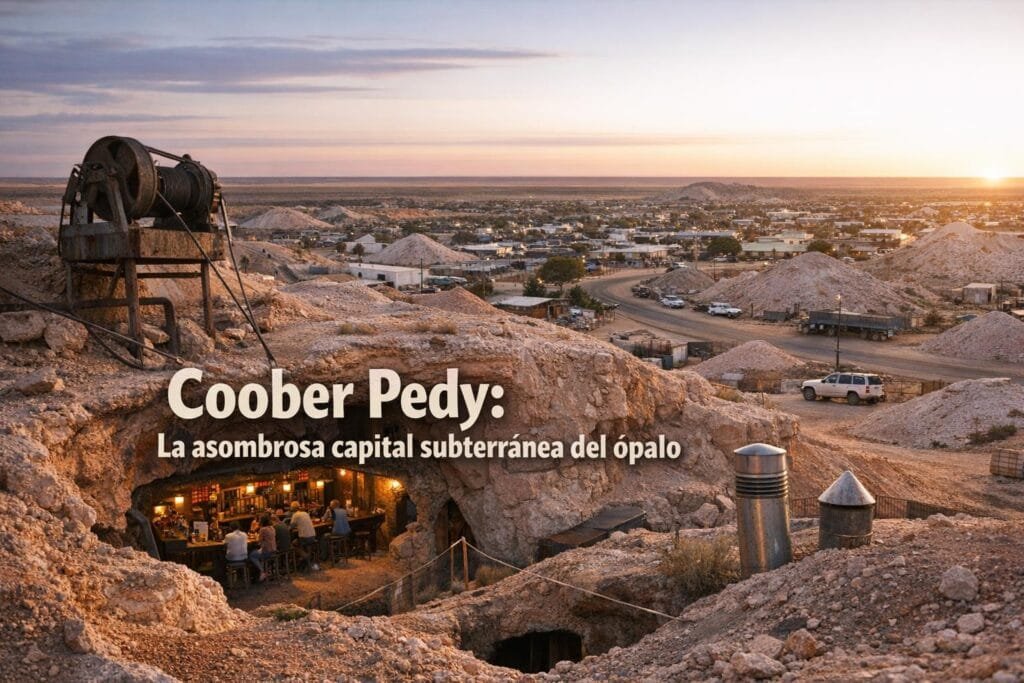
The sun is a relentless hammer, beating down as temperatures climb above 120°F. The air is dense and scorching; every breath feels hot. Red, dusty desert stretches to the horizon like a merciless oven. Living here sounds like a sentence. But what if, right beneath your feet, there were a lively town where life carries on in cool underground rooms? People here do not simply endure the open air—they have carved out their own refuge. Incredible, right?
Forget what you think you know about human settlements. In the heart of the punishing Australian Outback is a place that defies expectations. It is called Coober Pedy, one of humanity’s most astonishing and unusual experiments in survival. Here, living underground is not a quirk. It is the key to daily life.
This video gives you a look at life below the surface, where the rock itself provides the “air-conditioning.”
The dugout town: a challenge to life on the surface
If you have ever dreamed of escaping the summer heat, the people of Coober Pedy are way ahead of you. This unusual town in southern Australia is famous for two things: its status as the world capital of opal—nearly 95% of global production comes from the area—and its underground architecture. This is not a town with just a handful of basement homes. Most residents live in “dugouts,” rooms excavated deep into sedimentary rock. The network of adapted tunnels and caves contains houses, churches, museums, shops and even hotels.
The idea sounds like science fiction, but necessity can be a powerful motivator. Surface temperatures can become brutal, easily topping 120°F in summer, and nights offer little relief. Dust storms are common, and the sun is unforgiving. The solution was brilliantly simple: dig down. Just a few feet below the surface, temperatures stay relatively steady and comfortable, around 73–77°F year-round. Natural air-conditioning, courtesy of Mother Earth.
A hidden treasure beneath the relentless heat
Coober Pedy’s story began in the early twentieth century, when 14-year-old William Hutchison discovered opal in the area in 1915. The “colored gold” drew adventurers and miners from all over. They soon realized that life on the surface was punishing. At first, the caves they dug to search for gems became temporary shelters. Before long, the idea of turning those shelters into permanent homes took hold.
Miners expanded their excavations, turning mine passages into kitchens, bedrooms and living rooms. The relatively soft sandstone made the work easier. Little by little, an underground town took shape—not a city planned by urban designers, but an organic response to necessity and human ingenuity.
Life “down below”: a world of its own
If you visit Coober Pedy, what you see above ground is only the tip of the iceberg—or, more accurately, the tip of the dune. There are a few basic structures, including shops and the occasional home, but the real action is underground. Enter a house built into a hillside and you may find a surprisingly spacious home with several rooms, electricity, plumbing and every modern convenience. It is another piece of urban engineering that seems pulled from science fiction, only this time on a domestic, underground scale.
How does attending Mass in a church carved into rock sound, with its altar and pews cut from the stone itself? Or spending the night in an underground hotel, where the silence is absolute and the darkness promises deep sleep? In Coober Pedy, that is everyday life. The bare rock walls are often whitewashed or painted, but the feeling of being inside the earth never goes away.
Dugouts offer several advantages beyond temperature control:
- Quiet: Rock walls block outside noise and create a peaceful environment.
- Fewer pests: There are fewer flies, mosquitoes and other bugs than above ground.
- Natural protection: Dust storms and strong winds are simply not a problem indoors.
- Lower energy costs: Little air-conditioning or heating is needed.
Of course, it is not perfect. The lack of natural light can be challenging, though clever skylights and light wells help. And if you are claustrophobic, living beneath tons of earth may sound like a real nightmare.
Coober Pedy today: more than opals
Although opal mining remains the town’s main economic activity, Coober Pedy has also become a tourist curiosity. Thousands of visitors arrive every year, drawn by its unusual way of life and the promise of a lunar-looking landscape dotted with thousands of spoil heaps left by mining. It has even appeared in films such as The Adventures of Priscilla, Queen of the Desert and Mad Max Beyond Thunderdome, which captured its eccentric, post-apocalyptic atmosphere.
Coober Pedy’s adaptation is a testament to human resilience and creativity in the face of a hostile environment. The town invites you to look beyond the obvious, question what a home is supposed to be and marvel at how people can find beauty and function in the most extreme circumstances.
Who would have guessed that the secret to surviving a furnace on Earth could be, quite literally, beneath our feet? Next time the heat gets to you, you might think about more than turning on a fan—you might wonder what it would take to dig down. The world is full of astonishing corners, and we love discovering them with you.