
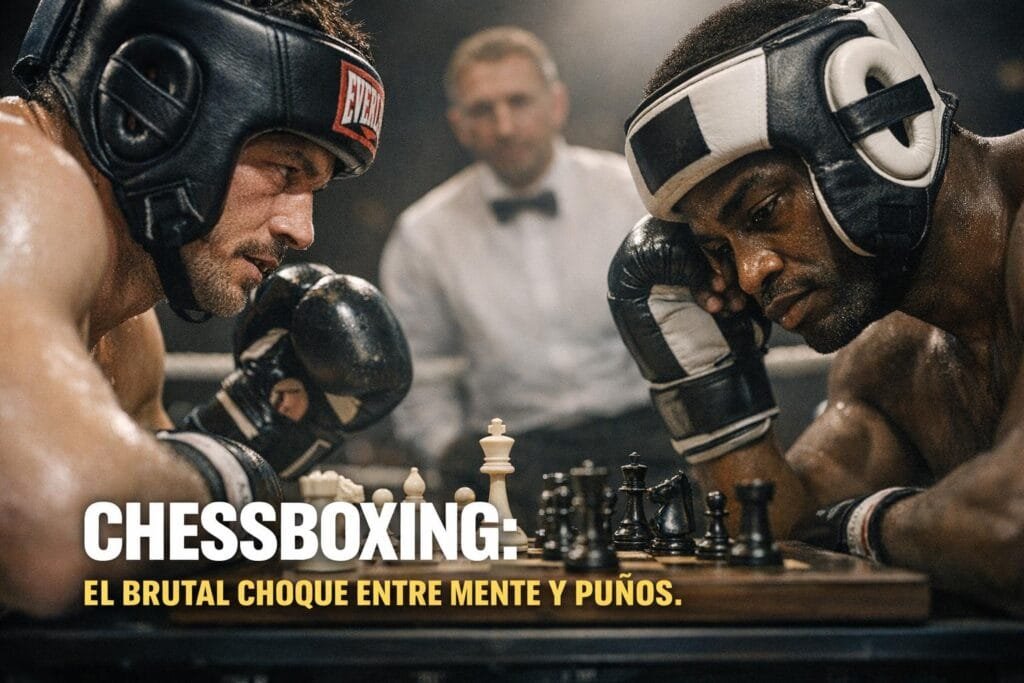
There are moments in human history when contradictions are celebrated: the sharpest mind and the hardest punch join forces, not for an honor duel but for a sport. Sounds like a joke, a failed social experiment or science fiction. Get ready for your brain to short-circuit, because the sport exists—and it is called chessboxing.
Yes, chess and boxing. At first glance, they have about as much in common as a classical concert and a wrestling match. It is a collision of worlds where the brain meets brute force. One demands composure, precise strategy and almost prophetic anticipation; the other requires aggression, pain tolerance and the ability to knock out an opponent. Who was the genius—or complete lunatic—who thought this was a good idea?
To see how this madness works in practice, watch the video below. It shows how quickly a cerebral strategy can turn into a right hook.
The birth of an unexpected hybrid
The idea may sound like something invented by a tipsy gentlemen’s club, but its roots go deeper—and are even stranger. Chessboxing did not emerge from a visionary’s garage. It came from a French comic. In 1992, artist and filmmaker Enki Bilal published Froid Équateur (Cold Equator), in which a world boxing championship is decided by a chess game. A satire on over-intellectualizing sports—or a premonition? Perhaps both.
A comic, however, is not real life. The person who took the idea off the page and into the ring was Dutch performance artist Iepe Rubingh. In 2003, Rubingh organized the first official chessboxing event in Amsterdam. Since then, the madness has attracted more fans. What began as an extravagant concept—and nearly a joke—has become a legitimate sport, with international federations, world championships and athletes who dedicate their lives to mastering both disciplines.
The combat paradox: how chessboxing works
The mechanics of chessboxing are a curious blend of absurdity and logic. It recalls other offbeat sports stories, such as the swimmer disqualified for being too good. Competitors alternate chess and boxing rounds. They do not simply play a quiet game after a fight. Here is the format described in this story:
- A match has up to 11 rounds.
- Odd-numbered rounds are chess; even-numbered rounds are boxing.
- Chess rounds last four minutes and boxing rounds three minutes, with a one-minute break between rounds for competitors to switch gear—gloves for brainpower, basically.
- The chess is fast chess: each player has 12 minutes for the entire game.
How do you win? There are several wonderfully contradictory routes:
- KO or TKO in boxing: The most direct and forceful option.
- Checkmate in chess: Mind triumphing over matter.
- Boxing judges’ decision: If there is no knockout, as in traditional boxing.
- Your opponent resigns in chess: White or Black can concede.
- Your opponent runs out of chess time: Another point for the mind—or lack of it.
- Disqualification: For breaking the rules of either discipline.
Imagine taking a hook that rattles your head and sitting down a minute later to decide whether sacrificing a knight is brilliant or your final blunder. Or making a flawless rook move and then having to dodge a punch aimed at your jaw. The contrast is brutal, almost poetic. You cannot be just a brainiac or a caveman. You have to be both, at once, in a precarious and fascinating balance.
Athletes with two sides
Chessboxing demands a combination few sports can match: extreme physical endurance, mental sharpness and an almost astonishing ability to switch gears. Training is an odyssey. One day you study the Sicilian Defense; the next, you hit a heavy bag as if there were no tomorrow. A good chessboxer must be a consummate strategist, able to anticipate moves with 30 seconds of boxing in their knuckles, and a relentless fighter who does not lose focus when a pawn threatens their queen.
This is not a sport for everyone. The psychological pressure is immense. A mistake at the board can cost you the game; a lapse in the ring can put you on the canvas. It is a ballet of punches and pawns, chess played in blood and sweat. In a way, it is a modern take on the Renaissance ideal: a complete person, capable of physical feats and refined intellect. Here, intellectual refinement happens with a black eye.
Mind-blowing or absurd? The big question
Chessboxing forces us to reconsider what we mean by sport, competition and even humanity. Is it a demonstration of how far mind and body can go when forced to cooperate in such opposing settings? Or is it another example of our endless need to invent oddities—like the most useless athletic record ever—that keep us glued to the screen out of sheer amazement?
There may be no single answer. What is undeniable is that chessboxing defies expectations. It shows there is no limit to human creativity—or to our ability to combine things that seem irreconcilable. In a world that often asks us to choose between reason and strength, this sport invites us to master both, with gloves and a brain.
The next time someone tells you intelligence and brute force are incompatible, remember chessboxing. Then maybe look for another of these wild sports stories on our blog. You never know what improbable combination is waiting around the corner.