
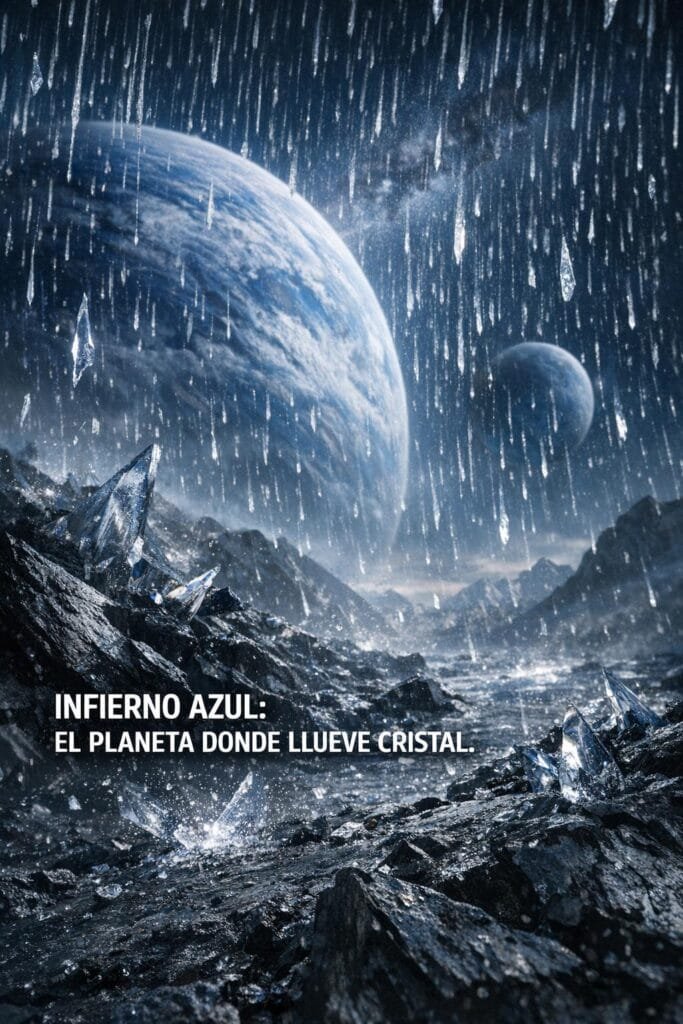
A deep-blue planet, a cosmic jewel that at first glance could look like Earth’s long-lost sister, floats serenely through space. Tempting, right? Do not be fooled by appearances: this celestial beauty hides an inferno. If you think getting caught in a downpour is unpleasant, imagine tiny silicate particles carried sideways by winds reaching thousands of miles per hour.
Welcome to the idyllic and terrifying world of HD 189733b. This exoplanet offers a cosmic reminder that not everything shiny is gold—and not everything blue is paradise.
The blue illusion: Earth twin or Van Gogh canvas?
To picture this hypnotic but lethal world, watch this visualization of its violent atmosphere. It offers a sense of why the blue “paradise” may actually be a glassy nightmare.
From a distance, this gas giant—about 63 light-years away in the constellation Vulpecula—looks spectacularly blue. Not a soft, diffuse blue like Neptune’s, but an electric, vivid, almost artificial shade. Early images and artist’s renderings of HD 189733b made it an exoplanet star because of its hypnotic color. You might picture deep oceans or an oxygen-rich atmosphere teeming with life, as if all the ingredients for life had gathered in one cosmic corner.
Reality, as often happens, is far less poetic and much more brutal. The blue is not caused by oceans or breathable air, but by something more exotic—and, frankly, dangerous: silicate particles scattering light in its atmosphere. It is as though the planet were wrapped in a veil of glass. And here is the interesting part: that “glass” is not standing still.
Hurricane-force winds and a very unusual rain
If the idea of a tropical storm makes you nervous, HD 189733b could literally strip you bare. This “hot Jupiter” orbits so close to its star that a year lasts just 2.2 Earth days. The intense heat raises atmospheric temperatures to about 2,400°F (1,300°C). Silicate is not solid mineral in those conditions; it is vapor that may condense into tiny particles. And the winds are so extreme that any precipitation could be driven sideways.
Imagine a world where “weather” is not limited to water droplets. On HD 189733b, winds can reach up to 5,400 miles per hour, roughly seven times the speed of sound. These cosmic hurricanes can carry silicate particles at supersonic speeds, creating a horizontal stream of abrasive projectiles. It is as if the planet were constantly being blasted with hot sandpaper.
You can almost picture clouds of incandescent particles sculpted by winds that make an Earth hurricane feel like a spring breeze. It is a deadly dance of elements, where surface beauty hides a perfect storm of destruction.
A hot Jupiter with a dark side
Like our Moon, which always shows Earth the same face, HD 189733b is tidally locked to its star. One side is perpetually exposed to its sun, while the other remains in eternal night. The temperature difference between day and night is enormous, and those variations help drive the planet’s extreme winds.
- Dayside: A scorching furnace where silicates vaporize and may later condense into tiny particles.
- Nightside: A dark, intensely cold realm where particles may solidify further before atmospheric circulation carries them back around.
It is a perpetual cycle of vaporization, condensation and sideways precipitation at unimaginable speeds. On this world, “shelter” is theoretical: there is nowhere to hide from weather that does not fall so much as cut horizontally across the atmosphere.
Why are we drawn to terrible beauty?
The story of HD 189733b is a fascinating reminder of the universe’s extreme diversity. It shows that our preconceptions about what a planet “should be” are often wrong. A blue world need not be habitable. It could instead be a place where the elements run wild, making a spectacular sight and a deadly trap for any life we know.
It is the ultimate paradox: a planet of undeniable beauty, with a color that suggests calm and life, but one that may be a cosmic wind tunnel scouring its atmosphere with glassy particles. We look out at such worlds with awe and a shiver, amazed at what nature can create—even when it defies every notion of hospitality.
The next time you gaze up at a starry sky and dream of other worlds, remember that cosmic jewels are not always what they seem. Some, like HD 189733b, are beautiful warnings wrapped in deep blue, inviting us to explore the universe’s often brutal imagination.
More stories that will blow your mind
Space and the history of science are full of episodes that sound fictional. If HD 189733b’s terrible beauty fascinated you, try these: