
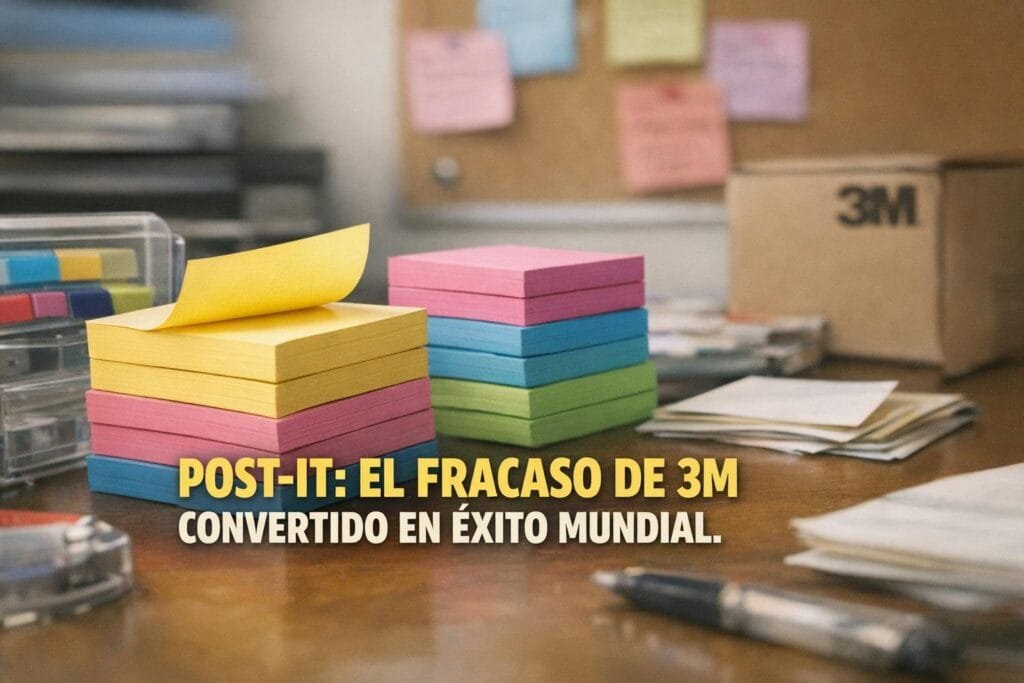
In the late 1960s, inside a bustling lab at the legendary 3M, a brilliant chemist named Spencer Silver had a clear goal: create an ultra-strong adhesive, something that would stick like a gorilla hug. After days, weeks, perhaps months of mixing and testing, what he got felt like a complete failure. Instead of clinging desperately, his glue stuck gently—and, even stranger, it could be peeled off and reapplied over and over without leaving a trace.
Disappointing, right? You aim for the summit of Everest and find a gentle hill. The adhesive was so stubbornly weak that Silver had no idea what to do with it. He presented his unusual invention at internal 3M talks, trying to convince colleagues it mattered, but no one could think of a practical use. What good is glue that does not stick well? The irony is delicious: he had created the seed of one of the modern office’s most ubiquitous inventions and did not know it. Nobody did—not for years.
This short video tells the remarkable story of serendipity in under three minutes. Press play.
The forgotten glue and a patient choir
For five years, Silver’s microsphere adhesive sat in 3M’s files, a technical curiosity and an apparent dead end in the search for a stronger bond. But fate, that unpredictable screenwriter, had other plans. Enter Art Fry, another 3M scientist with a quiet life and a surprisingly common problem: the bookmarks in his hymnal kept falling out. Every Sunday, the same frustration—trying to find the right page while the choir director looked on impatiently.
One day in 1974, the answer to his Sunday-morning agony arrived in an unexpected way. Fry attended one of the internal talks where Silver, persistent as an old professor, was presenting his sticky “failure” again. Suddenly, a light bulb went on. What if that adhesive could make bookmarks that stuck firmly enough not to fall out, but peeled away without damaging the pages? It would be a miracle for choir practice.
From hymnal to desk: an idea takes shape
Fry got to work. He took samples of Silver’s adhesive, applied them to small pieces of paper and—eureka!—it worked. He had solved his hymnal problem, but soon office colleagues were asking for those “notes” to mark documents without damaging them, leave temporary messages on desks or make to-do lists they could move around.
What had been a technical failure became a brilliant organizing tool in Fry’s hands and through his colleagues’ curiosity. A repositionable self-adhesive note that left no residue was completely new. It was a Post-it, though it did not have that name yet.
Resistance and the triumph of word of mouth
Despite the internal enthusiasm, the road to Post-it was not easy. 3M management was skeptical. A piece of paper with a little weak glue—who would buy that? It did not fit the company’s industrial product line or its strong adhesives. The thinking was, “If it does not stick firmly, it is not good glue.” And here is the irony: sometimes the biggest barrier to innovation is our own expectation of what a good product is supposed to be.
But Fry and Silver did not give up. They believed in the invention’s potential. In 1977, 3M tested it in four U.S. cities. Results were lukewarm. Still, they tried again in Boise, Idaho, with a different strategy: instead of selling the notes, they gave away samples to office workers. The response was explosive. Once people tried them, they did not want to live without them. Legend has it that 90% of the offices that tried the samples said they would buy them again.
That was word of mouth at its best. People discovered the usefulness for themselves, one of the most powerful forms of marketing. In 1980, 3M’s self-adhesive notes, now called Post-it Notes, launched nationwide in the United States and soon reached the rest of the world.
The legacy of a successful failure
Today, Post-it Notes are a cultural icon. They are in offices, homes and schools; they have appeared in movies, become an art medium and played a role in creative design. Who has not covered a wall with Post-its during a brainstorming session?
The Post-it story is a sticky paradox: a global product born from a lab “failure” and nearly rejected by its own company. It reminds us that innovation does not always come from pursuing what we already know works. Sometimes we have to notice what does not fit, what seems useless, and ask, “What if…?” The biggest success can hide behind a well-used mistake, a curious mind and a choir that refuses to lose its place in the hymnal.
How many everyday marvels are still waiting in the drawers of “failures,” or hidden in solutions to trivial problems? This world really is mind-blowing.
If you enjoyed this story…
Do not miss these other surprising origins: