
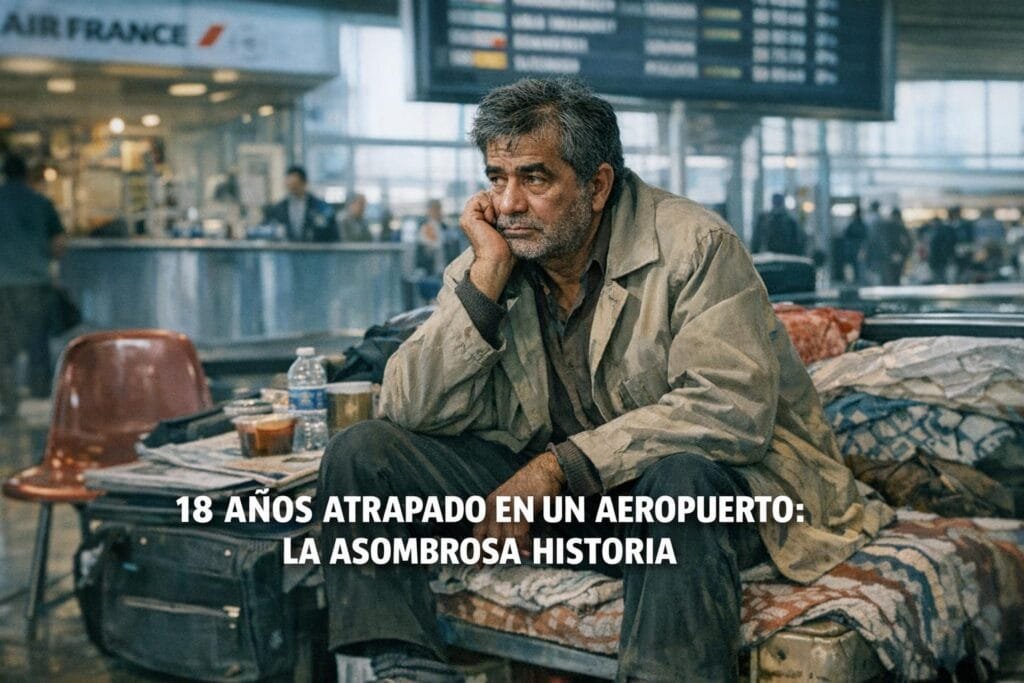
A man without a country or papers, whose only place in the world was an airport waiting area. Not for hours or days, but for 18 long years. It sounds like a cruel joke, doesn’t it? It was the life of Mehran Karimi Nasseri, an Iranian refugee whose existence became a walking paradox, trapped in the most surreal bureaucratic limbo imaginable.
At first glance, in Terminal 1 of Paris’s Charles de Gaulle Airport, it was easy to mistake him for another exhausted traveler. A middle-aged man with a luggage cart always nearby, perhaps a little scruffier than the average tourist but harmless. Yet he was not passing through. For Mehran, the departure lounge was no waiting room; it was home. His address was the baggage carousel, his pantry the airport restaurants, and his yard the endless corridors connecting the gates. His story is more than an anecdote: it is a monument to human resilience and, above all, the system’s absurd inflexibility.
It sounds like a movie script, but it is completely real. This short documentary explores the extraordinary details of his life in the terminal:
The maze began in Iran
Mehran Karimi Nasseri’s odyssey did not begin in Paris, but much earlier, in Tehran in the 1970s. Born in 1945, he went into exile in 1977 after taking part in student protests against Iran’s Shah. He traveled through several European countries seeking political asylum. In 1981, the United Nations eventually granted him refugee status in Belgium. With papers and the right to live in a country, it seemed his ordeal was over. But fate—or bureaucracy—had one more cruel turn in store.
In 1988, Mehran decided he wanted to move to the United Kingdom. He went to Charles de Gaulle Airport to catch a flight, but just before boarding, everything went wrong. The circumstances were never entirely clear: he said his briefcase containing his documents had been stolen; others suggested he mailed them and they were lost. Either way, he had no passport or refugee certificate. Legally speaking, he was a ghost.
When he arrived at Heathrow in London without the documents required to enter, he was sent back to Paris. At Charles de Gaulle, the problem repeated itself: without valid papers to enter France or leave the airport, he was stuck in a legal limbo. French authorities could not send him to Iran—he did not want to go and had no documents—could not send him to Belgium—he had relinquished his status there, or officials understood that he had—and he could not go anywhere else. Terminal 1 became his gilded prison, a jail without bars, made of departure gates.
A life between departure gates
The most surprising part is not how he ended up there, but how he managed to stay sane—or at least function—for nearly two decades. For Mehran, each day repeated a series of small rituals. He got up early, washed in staff restrooms and ate whatever little he could buy or was offered. His bench was a row of red plastic seats; his office, a metal table. He kept his few belongings on a luggage cart, hiding it in a discreet corner at night.
Airport staff—from security officers to cleaners and shop employees—went from initial disbelief to familiarity. Some affectionately called him “Sir Alfred,” acknowledging his strange royal air. They offered food, lent him newspapers and sometimes gave him a few euros. He became part of the scenery, as fixed a feature of the terminal as the flight screens or duty-free shops.
How did he pass the time? He read—a lot. Newspapers and magazines people lent him, books people gave him. He also wrote in his diary, a detailed chronicle of his existence in the terminal. He studied languages, watched travelers and listened to conversations. His world had shrunk to a few hundred square yards, but within that space his mind tried to expand. He developed an unusual routine that was, for him, the only way to maintain a semblance of normality.
“Sir Alfred” in real life—and in Hollywood
That very routine and unusual existence captured the world’s imagination. In the late 1990s, his story began appearing in the international press, drawing filmmakers’ interest. The most prominent was Steven Spielberg. Nasseri’s life inspired the 2004 film The Terminal, starring Tom Hanks as an Eastern European man stranded at a New York airport.
As films often do, it took creative liberties. Hanks’s character, Viktor Navorski, is a softened, happy-ending version of Mehran’s life. Viktor finds love and friendship in an almost idyllic way; Mehran’s reality was much bleaker and, in some ways, more tragic. He had no clear goal or mission. He simply was there. Fiction turned misfortune into adventure and irony into romantic comedy. Mehran even received a substantial sum for the rights to his story—a cruel irony for a man without possessions or a legal address who suddenly became an airport “millionaire.”
The end of the journey—and the return
Bureaucracy, as slow and convoluted as the airport itself, finally moved. In 1999, France granted him a provisional residence permit; in 2006, he became legally entitled to reside in France. He was offered a way out of the airport and the chance at a “normal” life. But after 18 years, Mehran had grown used to his “home.” At first, he resisted leaving, arguing that he was not “Sir Alfred” and could not sign the papers. The transit area was all he knew; the outside world felt foreign and intimidating.
Finally, in July 2006, after a health problem required hospitalization, Mehran Karimi Nasseri left the airport. Social organizations helped him find shelter. For a while, he lived in a hostel in Paris, far from the planes and flight announcements.
But airports have a strange pull on people forced to make them home. In September 2022, the story took another turn: Mehran Karimi Nasseri returned to Charles de Gaulle. He was not in transit or trapped in a bureaucratic limbo; he had simply gone back to the place where he had spent most of his adult life, the only place that perhaps felt like his. On November 12, 2022, at age 77, he died of natural causes in Terminal 2F. The circle had closed.
His life leaves us wondering: What is home when the law denies you one? What does freedom mean when it is within reach but you no longer know how to live it? Perhaps this is not just the story of a trapped man, but a reflection on how the limits imposed by the world can end up defining us. It is the kind of astonishing story only real life can write—and a reminder that between airports and passports, human existence finds surprising ways to unfold.
More stories that will blow your mind
Erasmus Thorne: genius, mystery and his astonishing tomato-only diet
Imagine a man, a true titan of the mind whose work transformed our understanding…
The man who tattooed an entire famous novel on his body
An extreme book fan turned his body into a canvas for his favorite work.
Amazing animals with official jobs: the mayor cat and other heroes
Dogs and cats with salaries and uniforms. This story sounds like fiction.