
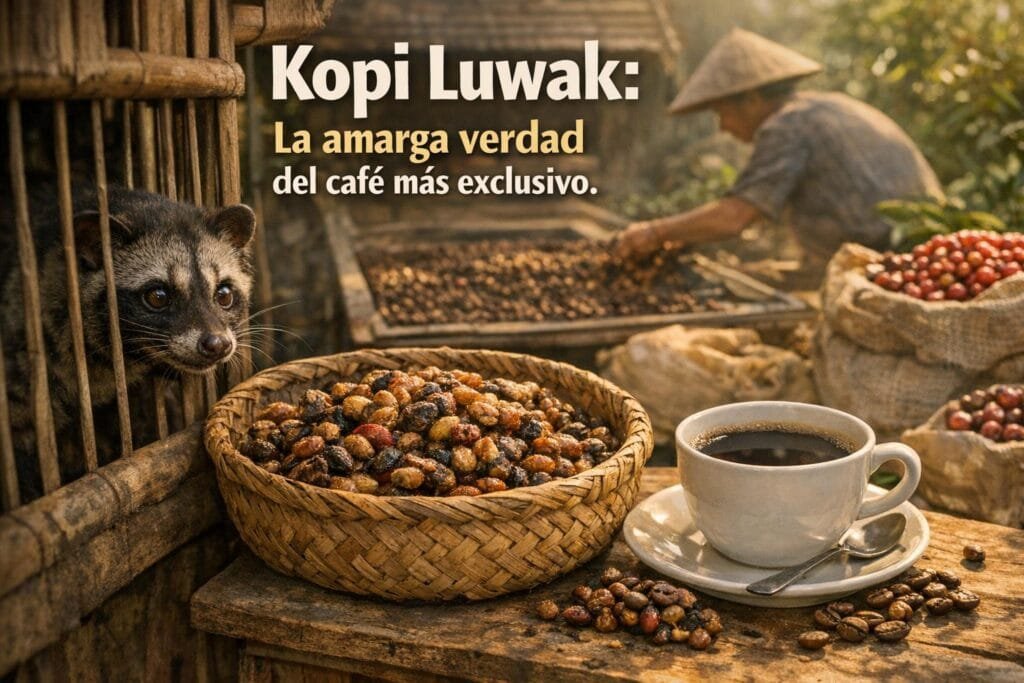
If someone told you the world’s most exclusive, expensive coffee had passed through an animal’s digestive system, you might think it was a tasteless joke—or a modern stunt designed to give the very rich something to talk about. But here we are, looking at a reality that challenges common sense and Western ideas of hygiene: kopi luwak, coffee made from animal droppings, is one of the most coveted drinks on the planet. And yes, it is exactly what you think.
In humanity’s endless quest for the extraordinary, we keep finding ways to turn the unusual into gold. In this case, the gold has a rather… organic origin.
For a visual overview of the process, from civet to cup, watch this short video:
The unlikely star: the civet
The protagonist is not a famous barista or meticulous coffee grower. It is a small, nocturnal, tree-dwelling mammal with a distinctive look that lives in Southeast Asia, especially Indonesia: the Asian palm civet, known locally as the luwak. The animal, which resembles a cross between a ferret and a mongoose, has a surprisingly selective palate.
Wild civets are fruit lovers. They seek out the ripest, reddest, best-looking coffee cherries rather than eating just any fruit. Here is where the magic—or the gross-out factor, depending on your point of view—begins: the animal swallows the whole cherry but does not digest the coffee bean inside.
- A natural process: Enzymes in the civet’s digestive tract act on the outside of the bean.
- Distinctive fermentation: Fermentation and partial digestion break down some proteins associated with coffee’s bitter taste.
- Excretion: The beans are eventually passed by the animal, ready to be collected.
Yes, you read that correctly: the beans are gathered from luwak droppings. They are then washed thoroughly, sun-dried, roasted and ground, like any other coffee. But their trip through a civet’s gut is what makes them different.
Why pay a fortune for poop coffee?
It is a fair question. What makes kopi luwak cost anywhere from €100 to €600 per kilogram—or even more—with a single cup topping €30 at some upscale cafés? Several factors combine to create its mystique.
1. A supposedly unmatched flavor
People who have tried it—and can afford it—describe kopi luwak as exceptionally smooth, with little bitterness. They report chocolate, earthy, caramel and fruity notes, a full body and a complex aroma. Reduced acidity and bitterness may result from enzymatic activity in the civet’s stomach. Fans call it a unique experience, unlike conventional coffee.
2. Rarity and exclusivity
Wild kopi luwak production is naturally limited. Civets are not coffee machines: each produces only a small number of beans a day, and gathering them from plantations is labor-intensive. As usual, scarcity pushes the price sky-high and turns the product into a status symbol.
The bitter side of a sweet luxury
As often happens with exclusive products in high demand, greed found its way in. Kopi luwak’s popularity has led to ethically questionable practices. At first, people collected beans left by wild civets—a more sustainable approach. As prices and demand rose, many producers began caging civets and force-feeding them coffee cherries to maximize output.
Captive production is a growing concern for animal welfare. Civets are wild, nocturnal animals; captivity, small cages, monotonous diets and intrusive tourism can cause severe stress. Coffee from caged civets may also be lower quality: the animals cannot select the best cherries or eat a varied diet, affecting natural fermentation and the final flavor.
If you decide to try this drink, look for credible producers who can show that the kopi luwak comes from wild civets and was collected ethically. Otherwise, you could pay a fortune for questionable coffee—and contribute to animal exploitation. The irony of seeking perfection in a cup at nature’s expense is hard to miss.
Is the experience worth it?
Whether kopi luwak is worth its price is deeply personal. Some consider it a unique culinary experience, an exotic indulgence worth the expense. Others see it as an over-the-top example of how the luxury market can distort value, especially when animal suffering is part of the hidden cost.
At the very least, kopi luwak invites us to think about the limits of curiosity, our appetite for the eccentric and the complicated ties between nature, culture and commerce. From a humble bean passed by a small animal to a drink that signals status, its story is as twisted and fascinating as its origin.
Who would have thought that the search for perfect coffee would take us down such… fecal paths? Kopi luwak is one more reminder that the world is genuinely mind-blowing and full of surprises—even in the least expected places.