
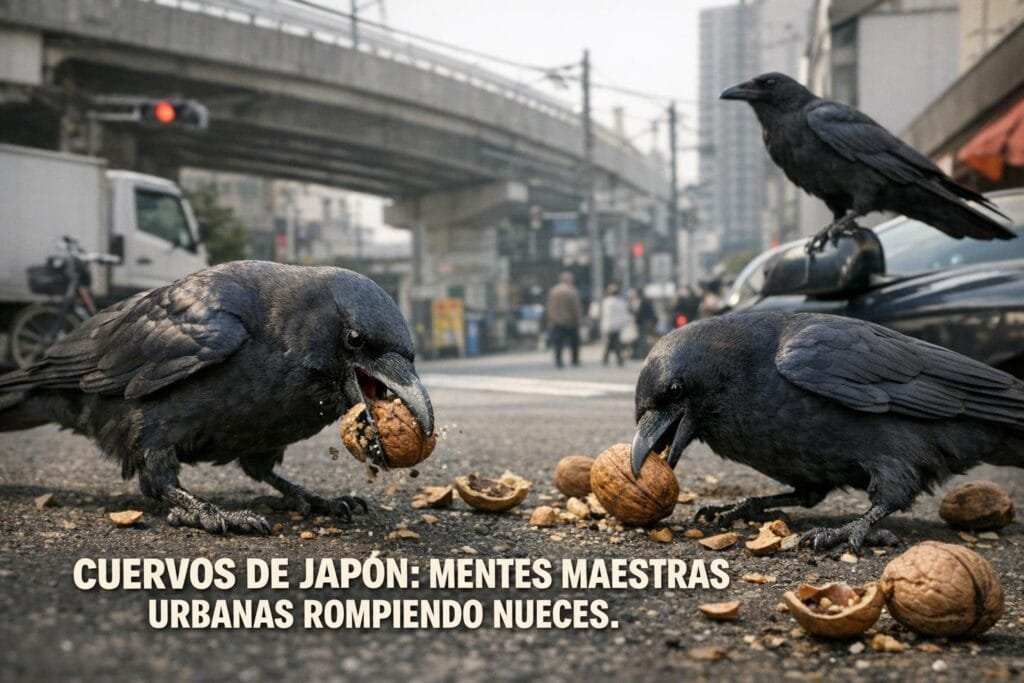
A red light on a busy street in Japan. You are cursing the delay and checking your phone again when you notice a crow. It is not pecking at crumbs or rummaging through trash. This crow is… waiting. Just like you. But it is not waiting to cross or for you to feed it. It is waiting for cars to do the dirty work. Who said humans are the only engineers on the planet?
The crows’ urban engineering
In cities such as Sendai, Tokyo and Hiroshima, crows have developed a technique that could put some urban planners to shame. They have figured out that walnuts—delicious, but frustratingly hard to open—can be cracked with a little ingenuity and some unintentional help from human infrastructure. Their method is as elegant as it is cheeky.
The behavior seems scripted, but it is real, as this video of their clever strategy shows:
Watch closely. A crow carries a hard-shelled nut over a crosswalk. It does not drop it at random—that would be amateur hour. The bird waits for the right moment, then drops the nut just as a car approaches the traffic light. The nut lands on the pavement, and the driver—unaware of their role in this avian scheme—crushes it under the tires. Crack!
So far, you might think it was an accident. But here is what elevates these crows to a higher class of thinker: once the nut has been conveniently broken, the bird does not rush in. If the light is green and traffic is flowing, the crow waits patiently. It waits for the light to turn red. Only when the cars have stopped and the crosswalk is safe for pedestrians—and for the crow—does it calmly land and collect the pieces of its meal.
A lesson in patience and strategy
This is not an isolated quirk; it is a pattern that has been observed and studied. It is evidence of remarkable adaptive intelligence. Think about what the behavior involves:
- Recognizing a problem: Nuts are hard to open.
- Identifying a “tool”: Cars and pavement.
- Understanding cause and effect: A car crushes the nut.
- Knowing the environment: Crosswalks and traffic lights offer safer ways to retrieve it.
- Patience and planning: Waiting for the right moment to drop the nut—and, crucially, to collect it.
It is a clear example of tool use, a cognitive milestone once thought exclusive to primates and a few other mammals. But corvids—the family that includes crows, ravens and magpies—keep showing us that their small brains are evolutionary marvels.
The brain behind the feathers
Crows have amazed us before. Their intelligence is legendary. They have been seen making tools from twigs or wire to extract food, solving multi-step puzzles, remembering human faces and even retaliating against people. Some studies suggest they can plan ahead, saving useful objects for later.
Their ability to adapt to urban environments—not merely surviving but thriving and exploiting our inventions—is fascinating. They learn from their surroundings and from one another. This “traffic-engineer crow” behavior has spread through whole populations, suggesting cultural transmission. It is as if there were a secret crow school teaching the best ways to get urban fast food.
The irony is hard to miss. We built the cities, designed the traffic systems and wrote the rules of the road. And there they are: birds we might consider less evolved, using our ingenuity for their own benefit. They watch us, understand more than we imagine and find the cracks in our system to make life easier—and walnuts more accessible.
A look toward the future (and the road)
The next time you stop at a red light, take a moment to look around. You might witness this display of avian cunning: a crow waiting with more patience than most humans, ready to retrieve lunch. While we wait for the light to change, the birds may be attending—or even teaching—a master class in ingenuity.
This phenomenon reminds us that intelligence does not always look the way we expect, or live where we assume. Sometimes it resides in a small, feathered brain capable of turning a traffic jam into an efficient nutcracker. Do we underestimate the intelligence around us? Or do we simply need to look beyond our routines to realize we are not the only planners on this planet? The world always has more surprises than we imagine, and here at El Mundo es Flipante, we love telling you about them.
More stories that will blow your mind
If these crows’ cleverness surprised you, wait until you discover other stories where intelligence, survival and eccentricity challenge what you thought you knew.