
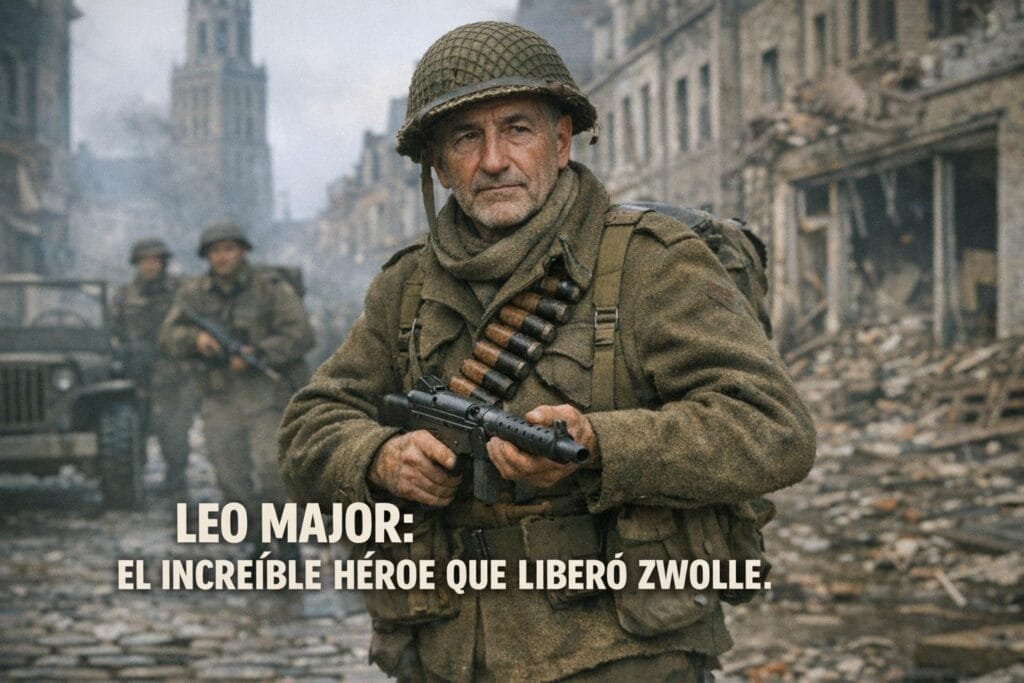
In the final stretch of World War II, the Allies were advancing to complete the liberation of the Netherlands, but German resistance remained fierce. The Dutch city of Zwolle was under Nazi occupation. The plan to free it was complicated: heavy artillery risked a massacre among civilians.
But what if I told you that the whole plan was upended because one French-Canadian soldier—with an eye patch and a defiant attitude—decided there was no time to wait and liberated the city by himself? It sounds like a B-movie script. It is the astonishing story of Léo Major, the “Lone Wolf” of World War II.
This short documentary gives you a sense of the man and the scale of his legend:
The most unbelievable gamble of the war
It is April 1945. Canadian forces are approaching Zwolle. The city is held by a Nazi detachment, and its commander is planning a massive assault as the war nears its end. The problem is always the same: civilians. A frontal attack could mean thousands of innocent deaths.
Then Sergeant Léo Major steps forward. He was a character, to put it mildly. He had lost an eye in a land-mine incident months earlier, but that did not stop him fighting. In fact, he made the eye patch part of his legend. He was an elite sniper, an exceptional scout and, let us be honest, an eccentric man prone to personal initiative—the kind that would make any officer attached to protocol shake their head.
Major already had a reputation for doing what he thought was right, and he often was right. He went to his superiors with a proposal that should have been rejected as absurd: he and a fellow soldier, Wilfred Arsenault, would enter Zwolle that night to assess German strength and contact the Dutch Resistance. The goal was not to liberate the city—not officially. It was only reconnaissance. But this was Léo Major.
The one-man show in Zwolle
The mission hit trouble almost immediately. After they had advanced only a few miles, a firefight with a German patrol killed Arsenault. Major, undeterred, hid his friend’s body and swore to avenge his death. From that moment, reconnaissance became something far more personal and audacious.
Armed with two submachine guns—one taken from a German soldier—a backpack and unwavering fury, Léo Major entered Zwolle alone in the dark. He came across a German staff car and, through a mix of nerve and luck, captured the vehicle and its driver. He forced the soldier to take him to a bar where he believed Gestapo officers gathered. When they arrived, Major fired a few shots and threw a grenade to simulate a large-scale attack, sowing panic.
This is where the story gets truly mind-blowing: Major was not just scouting. He was putting on a show. For hours he moved through the streets, firing his weapons in different places, throwing grenades, making noise and shouting in Dutch, English and German. He wanted the Germans to believe a much larger Canadian force had invaded the city—a force nobody had actually seen.
Chaos spread among the German occupiers. The night became a symphony of gunfire and explosions, orchestrated by one man. Disoriented and convinced they were under attack from every direction, German patrols began withdrawing in disarray. In a final act of swagger and strategy, Major even set fire to the Gestapo headquarters.
The city liberated by dawn
By sunrise, Zwolle was practically empty of German troops. In the middle of the night, Léo Major had contacted the Dutch Resistance and told them to stay home and get ready to celebrate: the city was about to be liberated. Resistance leaders initially thought he was crazy. One man? But seeing the German panic and retreat, they had no choice but to believe him.
At 4:30 a.m., Major returned to the Canadian lines, limping and exhausted but smiling. He told his stunned superiors the city was clear. They did not believe him, of course. How could one sergeant liberate an entire city? But when Canadian forces entered Zwolle that morning, they found it was true. The city was quiet, except for the cheers of the Dutch people.
The hero who did not want a medal (yet)
For this feat, Léo Major was recommended for the Distinguished Conduct Medal, one of the highest military decorations. True to form, he turned it down. His argument was: “I’m not a uniform man and I’m not qualified to wear a medal from British General Montgomery.” He preferred a French decoration—one more sign of his unusual personality and disregard for military formalities.
His story did not end there. After World War II, despite his injuries, he returned to combat in the Korean War, where he carried out another legendary feat: defending a strategic position against thousands of Chinese troops. He eventually earned the Distinguished Conduct Medal and Canada’s Distinguished Service Medal.
The echo of an unrepeatable feat
Léo Major’s incredible story in Zwolle makes you shake your head and wonder how it could have happened. It is individual courage taken to the extreme—a reminder that a little cunning, a lot of nerve and a healthy dose of madness can change events beyond what anyone expects.
In a world that often glorifies great battles and massive armies, Léo Major reminds us that individuals write history too: the one-in-a-million people who defy logic. So next time you hear about war heroes, remember the one-eyed sergeant who liberated a city alone. Is that not simply… mind-blowing?